
Gold Mutual Funds in Pakistan: How They Work, What They Cost, and What to Check First
Three gold mutual funds now exist in Pakistan. Here is how they hold gold, why none of them is 100% gold, what each one charges, and what to check before you put in your first Rs 10,000.

The short answer: A gold mutual fund lets you hold gold without keeping any at home. Pakistan now has three: Meezan Gold Fund, NBP Islamic Gold Fund and Mahaana Islamic Gold Fund. All three keep 70 to 90 percent in PMEX gold and the rest in bank deposits, so none is fully gold, and each charges fees that are easy to miss.
This is general information, not investment advice. Gold's price moves both ways and a gold fund can lose value. Figures below are quoted from each fund's own documents with dates; fees change, so check the current Key Fact Statement before you invest.
If gold is the one asset you already trust, you are in good company. Many Pakistani households hold some. The problem was never the gold. The problem is the locker, the almari, the trip to the jeweller with cash in your pocket, and the quiet worry every time you leave the house.
A gold mutual fund is one answer to that worry. It has been available in Pakistan since 2015, but for most of the past decade only one was open to investors. Now there are three, and the newest opened for subscription this month. So this is a good moment to explain, slowly, what you would actually be buying.
Key Takeaways
- A gold fund holds gold contracts on PMEX in a vault, and you hold units of the fund, not tola.
- By rule, a gold fund keeps 10 to 30 percent in bank deposits, so it is never 100 percent gold.
- Three open-end gold funds exist in Pakistan: Meezan, NBP Islamic and Mahaana.
- Fees come in layers: a management fee inside the price, a front-end load when you buy, and a price adjustment charge both ways.
- Redemption money can take up to six business days to reach your bank.
- Zakat is deducted at source on the first of Ramadan unless you file a declaration.
What is a gold mutual fund, in plain terms?
A gold mutual fund is a mutual fund whose job is to own gold. Many people put money into one pool. An asset management company, the AMC, uses that pool to buy gold contracts on the Pakistan Mercantile Exchange. You receive units of the fund in proportion to what you put in.
The price of one unit is its NAV, calculated every working day from the value of everything the fund holds divided by the number of units. When gold goes up, the NAV goes up. When gold falls, so does the NAV. Our guide to NAV walks through the arithmetic.
Two things matter for a first-timer. You own units, not metal. And the fund is regulated by the SECP as an "open-end commodity scheme", which means it follows a rulebook about what it may hold and what it may charge. That rulebook is what makes the three funds look so alike.
A gold fund is a promise to hold gold on your behalf, wrapped in the rules of a mutual fund, with a slice of cash that is never gold.
Where does the gold actually sit?
In a vault, under the exchange's custody, and the fund never hands bars to anyone.
Each fund buys what its documents call "deliverable gold contracts" on PMEX. NBP's offering document states that investments "shall only be made in contracts which will be backed by physical gold" and describes vault custody and takaful cover as costs the fund pays. Mahaana's own page says the gold is "held in PMEX's vaults" and that "you do not take bars home". Meezan's notices over the years refer to buying physical gold through PMEX.
The fund's assets are held by a trustee that is separate from the AMC. For all three funds the trustee is the Central Depository Company (CDC). That separation is the point: the company that runs the fund is not the company that holds the fund's property. If you want the longer version of who holds what, we wrote it up in who actually holds your gold and your money.
What you cannot do is walk in and ask for your tola. A gold fund settles in rupees. You sell units, and the money comes to your bank account.
Why is a gold fund never 100 percent gold?
Because the rules do not allow it, and because the fund needs cash to pay people who leave.
All three funds publish the same allocation limits: 70 to 90 percent of net assets in gold contracts, 10 to 30 percent in cash and near-cash with Islamic banks. Their benchmark is built the same way, 70 percent PMEX gold and 30 percent the average savings rate of three AA-rated Islamic banks.
In practice the funds run closer to the top of the gold range. Meezan Gold Fund reported 86.6 percent in gold and 12.7 percent in cash at the end of June 2026 (Fund Manager Report, June 2026). NBP Islamic Gold Fund reported 82.5 percent in commodities and 16.7 percent in cash at the end of August 2026 (Fund Manager Report, August 2026).
The consequence is simple and worth saying plainly: a gold fund tracks the gold price approximately, not exactly. In a month when gold rises sharply, the fund rises less because part of it was sitting in a bank. One dated illustration, offered as a single month and not a pattern: NBP's August 2026 report notes that international gold rose around 9.4 percent that month while the fund's NAV rose 5.9 percent. Part of that gap is the cash sleeve; the rest comes from fees, currency movement and the difference between international and PMEX prices. The point is only that the fund and the metal do not move one for one, in either direction.
None of that is a flaw. It is the design. But if you came expecting a digital tola that moves exactly with the bazaar rate, this is the first thing to adjust.
Which gold funds exist in Pakistan right now?
Three open-end funds, all Shariah-labelled commodity schemes, all using PMEX gold and CDC as trustee. Listed by age, not by preference.
Meezan Gold Fund (Al Meezan Investment Management). Launched 13 August 2015 and, for most of the past decade, the only one still open. Net assets of about Rs 9.7 billion at 31 July 2026 (Al Meezan fund page). It has been closed to new money more than once when PMEX could not supply physical gold, most recently from September 2023 until the suspension was lifted in September 2025. That history is worth knowing: a gold fund can pause taking new investors.
NBP Islamic Gold Fund (NBP Fund Management). Launched 4 May 2026 at a par value of Rs 10 per unit. About Rs 672 million in net assets at 31 August 2026 (Fund Manager Report, August 2026). Its offering document describes it as passive: it stays at least 70 percent in gold regardless of the manager's view on prices.
Mahaana Islamic Gold Fund (Mahaana Wealth). The newest, opened for subscription in September 2026 through the Mahaana app. Its Key Fact Statement was issued in March 2026. As a fund in its first weeks it has no expense-ratio history yet, so some cells in the table below are blank on purpose rather than guessed.
You may also see "gold" options inside pension funds from Meezan, UBL, NIT and Lucky Investments. Those are voluntary pension sub-funds with their own rules and tax treatment, not open-end mutual funds, and they are outside this article.
What do the three gold funds charge?
Every figure below is from the fund's own Key Fact Statement, offering document or latest Fund Manager Report, as read on 6 September 2026. "Up to" means the maximum the fund is allowed to charge; the actual can be lower and can change.
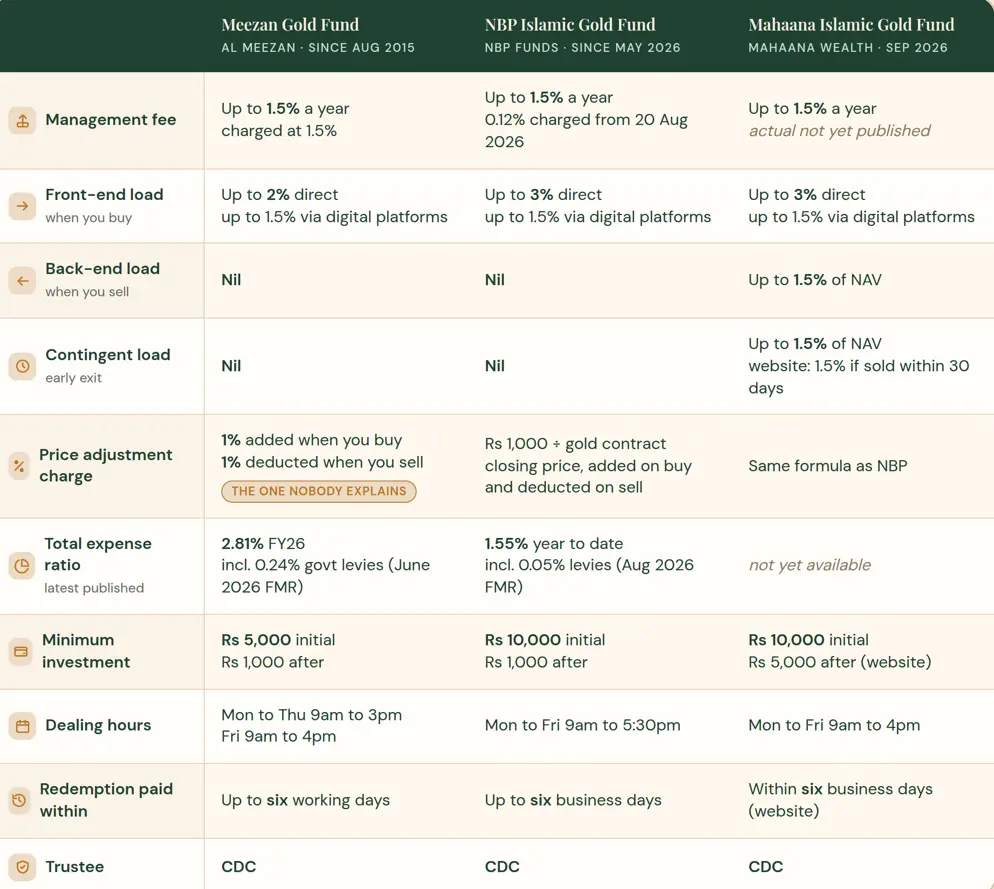
Sources: Al Meezan MGF Key Fact Statement (18 June 2025) and FMR June 2026; NBP Islamic Gold Fund Offering Document (March 2026) and FMR August 2026; Mahaana Islamic Gold Fund KFS (March 2026) and mahaana.com/gold. Fund categories and NAVs are listed at MUFAP. Government levies inside the expense ratio are paid by unit-holders.
How should a first-timer read that fee table?
Three readings, in order of how much they matter.
The management fee is the number everyone quotes, and it is the least useful one on its own. It sits inside the total expense ratio, which is the real annual cost and includes trustee fees, SECP fees, audit, Shariah advisory, vault custody and levies. Compare expense ratios, not management fees. NBP's low charged fee and expense ratio are those of a fund in its first months; new funds often start low and the figure can change.
The front-end load is the fee you feel. Buying through the AMC's own app or a digital platform is generally capped at 1.5 percent; walking into a branch can cost up to 2 or 3 percent. The same fund, two prices, depending on the door you use.
The price adjustment charge is the fee almost nobody explains. It exists because PMEX gold has a buying price and a selling price, a spread, and the fund passes that gap to whoever is entering or leaving so that existing investors are not diluted. At Meezan it is a flat 1 percent each way. Add a full front-end load on top and you are about 3 percent behind the moment you buy, before the metal has moved at all, and another 1 percent goes when you sell. Because so much of the cost is paid on entry and exit, buying and selling often makes a gold fund expensive. These are built for holding, not trading.
What are the costs and caveats that do not appear in the fee table?
Four things, each small on its own and easy to miss.
You never see the expense ratio leave your account. It is deducted inside the NAV, a little every day. Your statement will never show a debit called "fees", which is why so many investors believe their fund is free. It is not free; it is quiet.
The cash sleeve has a cost in a rising market. Covered above, but it belongs in this list. Between 10 and 30 percent of your money earns a bank rate rather than following the gold price, in every month, by rule.
A fund can pause new investment. Meezan's fund suspended fresh issuance in January 2022 and again from September 2023 when physical gold was not available through PMEX (Al Meezan notices, 2022 and 2023), and reopened in September 2025. Your existing units were unaffected, but if you were planning monthly top-ups, the door was shut. This is a feature of how these funds source gold, not a failing of one AMC.
Selling takes days, not minutes. The rules give a fund up to six working days to pay you after a valid redemption request (NBP offering document, §4.5; the same regulatory limit applies to all open-end funds). In practice it is often faster, but plan for six. Money you might need next Tuesday should not be in a gold fund on Friday.
What about tax and zakat on gold funds?
Two deductions, and both depend on your paperwork.
When you redeem units at a gain, capital gains tax applies. The rate depends on whether you are on the Active Taxpayers List and on the Finance Act in force at the time; it is withheld by the AMC when you sell. Whether you still need to report it in your return depends on your situation, so check with a tax adviser. We do not print a rate here because it changes, and because non-filers pay a higher rate. If you are not sure of your status, start with how to check your filer status.
Zakat is the one that surprises people. For resident individual investors, funds deduct zakat at 2.5 percent of the value of your holding on the first day of Ramadan, at source, unless you have filed a zakat declaration (form CZ-50) with the fund. If you already pay zakat yourself, file the declaration when you open the account, not in Shaban. NBP's offering document spells this out; the mechanism is standard across funds.
What should a first-timer check before buying any gold fund?
Five things, in the order you will meet them.
- Read the Key Fact Statement, not the brochure. It is two pages, it is on the AMC's website, and it contains every number in the table above.
- Find the gold percentage in the latest Fund Manager Report. Every AMC publishes one monthly. If it says 75 percent, a quarter of your money is in a bank.
- Ask which load applies to you, in writing. App or branch, direct or through a distributor. Then ask about the price adjustment charge.
- Know your exit timeline and your exit cost. Up to six days to get paid; a contingent load if you leave early where one applies.
- Sort your filer status and your zakat declaration before you invest, not after. Both change what you receive when you sell.
None of this requires an expert. It requires twenty minutes with two PDFs.
Frequently asked questions
What is a gold mutual fund in Pakistan?
A gold mutual fund pools money from many investors and uses it to buy gold contracts on the Pakistan Mercantile Exchange, with the gold held in vaults under a trustee. You own units of the fund priced daily by NAV, not the metal itself. The SECP regulates these funds as open-end commodity schemes.
Which gold mutual funds are available in Pakistan?
Three open-end gold funds exist as of September 2026: Meezan Gold Fund (Al Meezan, since 2015), NBP Islamic Gold Fund (NBP Funds, since May 2026) and Mahaana Islamic Gold Fund (Mahaana Wealth, subscriptions opened September 2026). Gold sub-funds inside pension schemes are a separate product.
Is a gold fund 100 percent gold?
No. By rule these funds hold 70 to 90 percent in PMEX gold contracts and 10 to 30 percent in bank deposits, so they track the gold price approximately. Recent reports showed Meezan at about 87 percent gold (June 2026) and NBP at about 83 percent (August 2026).
What are the fees on Meezan Gold Fund?
As of its June 2025 Key Fact Statement and June 2026 report: management fee 1.5 percent a year, front-end load up to 2 percent (up to 1.5 percent on digital platforms), no back-end load, a 1 percent price adjustment charge on both buying and selling, and a total expense ratio of 2.81 percent for FY26. Check the current KFS before investing.
Can I take physical gold from a gold mutual fund?
No. Gold funds settle in rupees. When you redeem, you sell units at the day's NAV and the money is paid to your bank account, normally within six working days. The physical bars stay in the exchange's vaults; delivery of bars is not a feature of any of the three funds.
Is there tax when I sell gold fund units?
Yes. Capital gains tax is withheld by the AMC when you redeem at a gain, at a rate that depends on your filer status and the current Finance Act. Zakat of 2.5 percent is also deducted on the first of Ramadan unless you have filed a CZ-50 declaration.
How much do I need to start a gold fund?
Meezan Gold Fund starts at Rs 5,000; NBP Islamic Gold Fund and Mahaana Islamic Gold Fund start at Rs 10,000, per their published documents and websites as of September 2026. Subsequent investments are lower, from Rs 1,000 at Meezan and NBP and Rs 5,000 at Mahaana.