
How Much Money Do You Really Need to Start Investing in Pakistan?
You can start investing in Pakistan from as little as Rs 100. With inflation at 11.1% in June 2026, the real barrier was never money—it's knowing how

You can start investing in Pakistan with as little as Rs 500 in digital gold, or roughly Rs 500 to Rs 5,000 in a mutual fund. You don't need lakhs. In June 2026, inflation ran at 11.1% (Pakistan Bureau of Statistics, 2026), so the costly part isn't starting small. It's waiting for a "big enough" amount that never quite arrives.
If you've been saving up to invest "properly" one day, this guide is for you. The truth is gentler than the myth: the amount you begin with matters far less than the habit you build around it.
Key Takeaways
- Digital gold starts from about Rs 100, and many mutual funds from Rs 500 to Rs 5,000. The minimum to begin is far lower than most people assume.
- Only 4% of Pakistani savers keep money in a formal financial institution, and 77% of adults lack basic financial literacy (SBP; URCAPK, 2025). The barrier is knowledge, not capital.
- Rs 5,000 invested monthly at a 12% long-run return (the KSE-100's historical average) can grow past Rs 11 lakh in 10 years and near Rs 50 lakh in 20. Consistency beats size.
The rupee figures in this article are illustrations based on an assumed 12% annual return (the KSE-100's long-run historical average). They are not projections, advice, or promised returns — markets rise and fall, and your actual results will differ.
So how much do you actually need?
Less than the price of a family dinner out. Digital gold can be bought from around Rs 100, and several mutual funds let you start from Rs 500 to Rs 5,000, especially the low-entry "Sahulat" accounts built for first-time investors. The Pakistan Stock Exchange needs a bit more to be practical, but even there you're talking thousands, not lakhs.
Here's a realistic look at where each option begins:
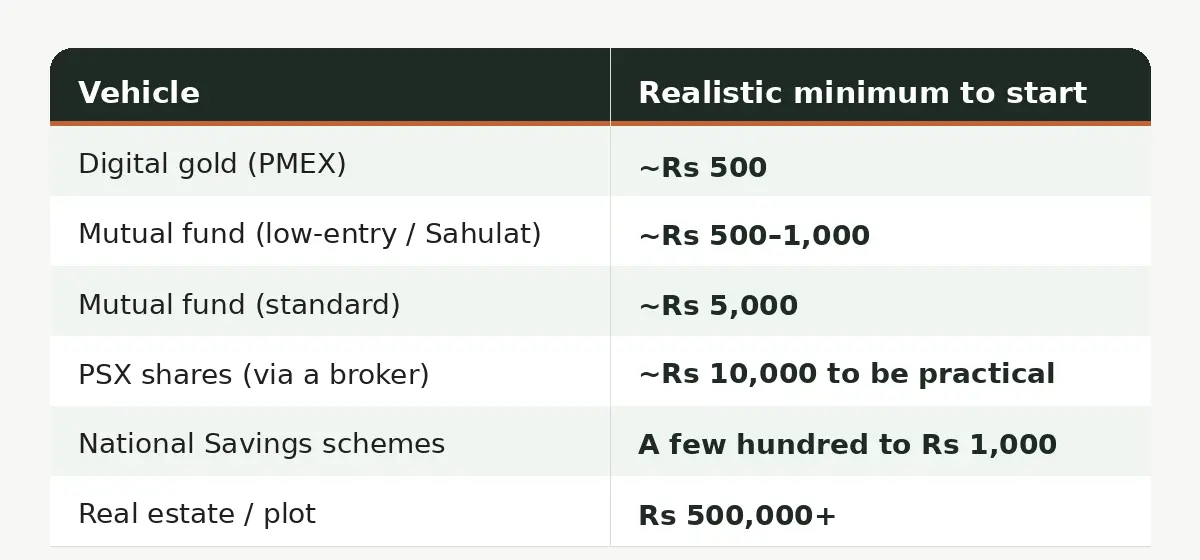
These figures are indicative and vary by provider, but the pattern is clear. Every avenue except property is open to someone with a modest monthly salary. Pakistan's mutual fund industry now manages about Rs 3.93 trillion in assets (MUFAP, 2025), and a growing share of that comes from small, regular savers, not the wealthy.
Why the "I'll start when I have more" trap costs you
Waiting for a bigger amount is the single most expensive habit in personal finance, because the cost is invisible. Every month your money sits in cash, inflation of 11.1% quietly trims its value, while the compounding you could have earned never begins (Pakistan Bureau of Statistics, 2026).
Think about what "saving up to invest" really means. You hold cash for a year to build a lump sum, but that cash loses purchasing power the whole time, and you miss a year of potential market growth. You end up with a bigger number that buys less and started later. The lump-sum plan often loses to the person who simply began with Rs 2,000 a month.
This is why financial inclusion data is so telling. Pakistan's inclusion rate reached 67% in 2025 (Arab News, 2025), yet most savers still park money where it cannot grow. The gap isn't ambition. It's the belief that investing is for "later," once life is sorted. Life is never quite sorted. Begin anyway.
What can Rs 1,000 or Rs 5,000 a month actually become?
A surprising amount, because time does the heavy lifting, not the size of each deposit. At the KSE-100's long-run average return of about 12% a year (Trading Economics, 2026), small monthly investing compounds into figures that feel out of reach when you start.
Notice the shape. Most of the growth arrives late, which means the most valuable thing you can give your money isn't a large deposit. It's time. We explain the engine behind this in our guide to what compounding is and why it matters.
What about fees, taxes, and hidden costs on small amounts?
They exist, but on a beginner's portfolio they're small enough not to delay you. Mutual fund management fees in Pakistan are capped by the SECP, ranging from about 1.0% on money market funds to a maximum of 3.0% on equity funds. On Rs 5,000, that's a few rupees a month, built into the price automatically.
The bigger risk for small investors isn't fees. It's choosing a high-cost or high-churn approach that eats returns through frequent trading. Keeping things simple, with one diversified fund and a monthly transfer, keeps costs low by design. For a side-by-side look at fees across options, see our comparison of mutual funds vs PSX vs digital gold.
One honest note on faith: if Shariah compliance matters to you, low-entry Islamic funds exist. Pebble doesn't certify anything as halal, but the structures are there, reviewed by Shariah boards, for you and a scholar you trust to assess.
How do you start with a small amount this week?
Start with one decision, not a perfect plan. The goal this week is simply to move from "thinking about it" to "doing it," with whatever amount won't disrupt your month.
- Pick an amount you won't miss: Rs 1,000, Rs 2,000, or Rs 5,000.
- Choose one beginner-friendly vehicle (a balanced mutual fund is the classic first step).
- Complete the account opening with your CNIC; many platforms are fully digital now.
- Make the first transfer, then automate it for the same date each month.
- Check in monthly, not daily, and let it run.
For the full walkthrough, including accounts and what to pick first, follow our beginner's roadmap to start investing in Pakistan. And if you're still asking whether investing is even worth it, start with what investing is and why it matters.
Frequently Asked Questions
What is the minimum amount to start investing in Pakistan?
About Rs 100 for digital gold and roughly Rs 500 to Rs 5,000 for many mutual funds, especially low-entry Sahulat accounts. The PSX needs more to be practical, usually around Rs 10,000. With inflation at 11.1% in June 2026, starting small beats waiting (Pakistan Bureau of Statistics, 2026).
Is it worth investing such a small amount?
Yes. At a 12% long-run return, Rs 5,000 a month can grow past Rs 11 lakh in 10 years and near Rs 50 lakh in 20 (Trading Economics, 2026). The habit and the time invested matter more than the size of each deposit.
Do I need a lot of money for the stock market?
No, but you need a bit more than for funds. A practical PSX starting point is around Rs 10,000, enough to buy a few shares without fees eating your returns. Many beginners start with a mutual fund first, then add direct shares later.
Will fees eat up my returns if I invest small amounts?
Not meaningfully. Mutual fund fees are SECP-capped between roughly 1.0% and 3.0% a year and are built into the price. On a Rs 5,000 investment, that's a few rupees. Frequent trading, not fund fees, is what usually harms small portfolios.
How much of my salary should I invest?
A common starting point is 10-20% of income, but any consistent amount works. Build a small emergency fund first, then invest what you won't need for 5+ years. Even 5% of your salary, invested monthly, compounds powerfully over time.
The bottom line
The question was never really "how much do I need?" It was "what's stopping me?" And the honest answer, for most people, is a myth: that investing belongs to those with lakhs to spare.
It doesn't. It belongs to anyone willing to start with a little and stay consistent. Rs 100 in gold or Rs 1,000 in a fund won't change your life this month. But it starts the clock, and the clock is the part you can never get back.
Pick your amount. Open one account this week. Let time do the rest. Here's how to take that first step.
Sources
- Pakistan Bureau of Statistics. "Monthly Inflation Report for June 2026" — CPI 11.1% year-on-year (eased from 11.7% in May 2026). Retrieved 2026-07-10, from https://www.pbs.gov.pk/monthly-inflation-report-for-june-2026/
- Business Recorder. "Pakistan inflation hits 11.1% in June 2026." Retrieved 2026-07-10, from https://www.brecorder.com/news/40428026/pakistan-inflation-hits-111-in-june-2026
- Trading Economics. "Pakistan Stock Market (KSE-100) — Returns and Historical Data." Retrieved 2026-06-11, from https://tradingeconomics.com/pakistan/stock-market
- Mutual Funds Association of Pakistan (MUFAP). "Industry Assets Under Management." 2025. Retrieved 2026-06-11, from https://www.mufap.org.pk/
- Arab News. "Pakistan's financial inclusion jumps to 67% as macroeconomic indicators improve." December 2025. Retrieved 2026-06-11, from https://www.arabnews.com/node/2618327/pakistan
- State Bank of Pakistan. "National Financial Inclusion Strategy / Financial Inclusion Index." 2025. Retrieved 2026-06-11, from https://www.sbp.org.pk/ACMFD/National-Financial-Inclusion-Strategy-Pakistan.pdf
- URCAPK. "Financial Literacy Report: Pakistan." 2025. Retrieved 2026-06-11, from https://urcapk.com/
- Securities and Exchange Commission of Pakistan (SECP). "Total Expense Ratio caps for mutual funds." 2025. Retrieved 2026-06-11, from https://www.secp.gov.pk/