
How to Start Investing in Pakistan: A Beginner's Guide to Building Wealth
77% of Pakistanis lack financial literacy. Learn the 6-step roadmap to overcome barriers, choose the right investment avenue, and start building wealth—even with Rs 5,000.

Right now, inflation is eating your money.
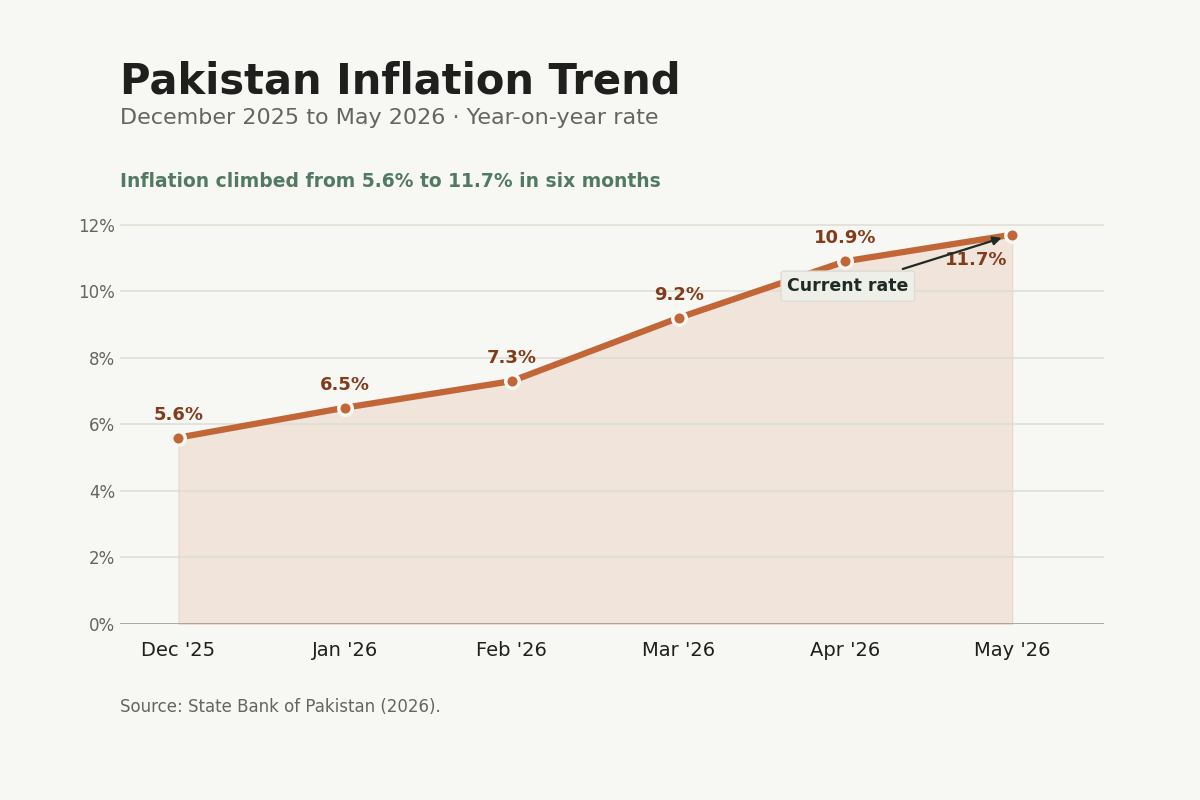
If you kept Rs 100,000 in a savings account over the last year, you lost roughly Rs 11,700 in purchasing power. In May 2026, Pakistan's inflation hit 11.7%, the highest since June 2024 (State Bank of Pakistan, 2026). That's not pessimism. That's math.
Yet most Pakistanis are frozen. They don't start investing because they think they don't understand it, can't afford it, or shouldn't risk it without asking family first. The irony: doing nothing is the biggest risk of all.
This guide is for anyone who's meant to start "eventually" and keeps meaning to. It's not jargon-heavy. It won't promise 30% returns or claim anything is "halal" without backing. And it won't shame you for not knowing where to begin. This is the honest, step-by-step roadmap.
Key Takeaways
- In May 2026, inflation reached 11.7% every rupee in a savings account loses value (State Bank of Pakistan). Investing is no longer optional; it's necessary to protect your wealth.
- 36% of Pakistanis remain financially excluded, yet the Pakistan Stock Exchange added 120,000 new investors in 2025 alone—momentum is building.
- You can start with as little as Rs 5,000 through mutual funds. The barrier isn't money. It's knowledge and permission (which you're about to grant yourself).
Why Most Pakistanis Never Start Investing
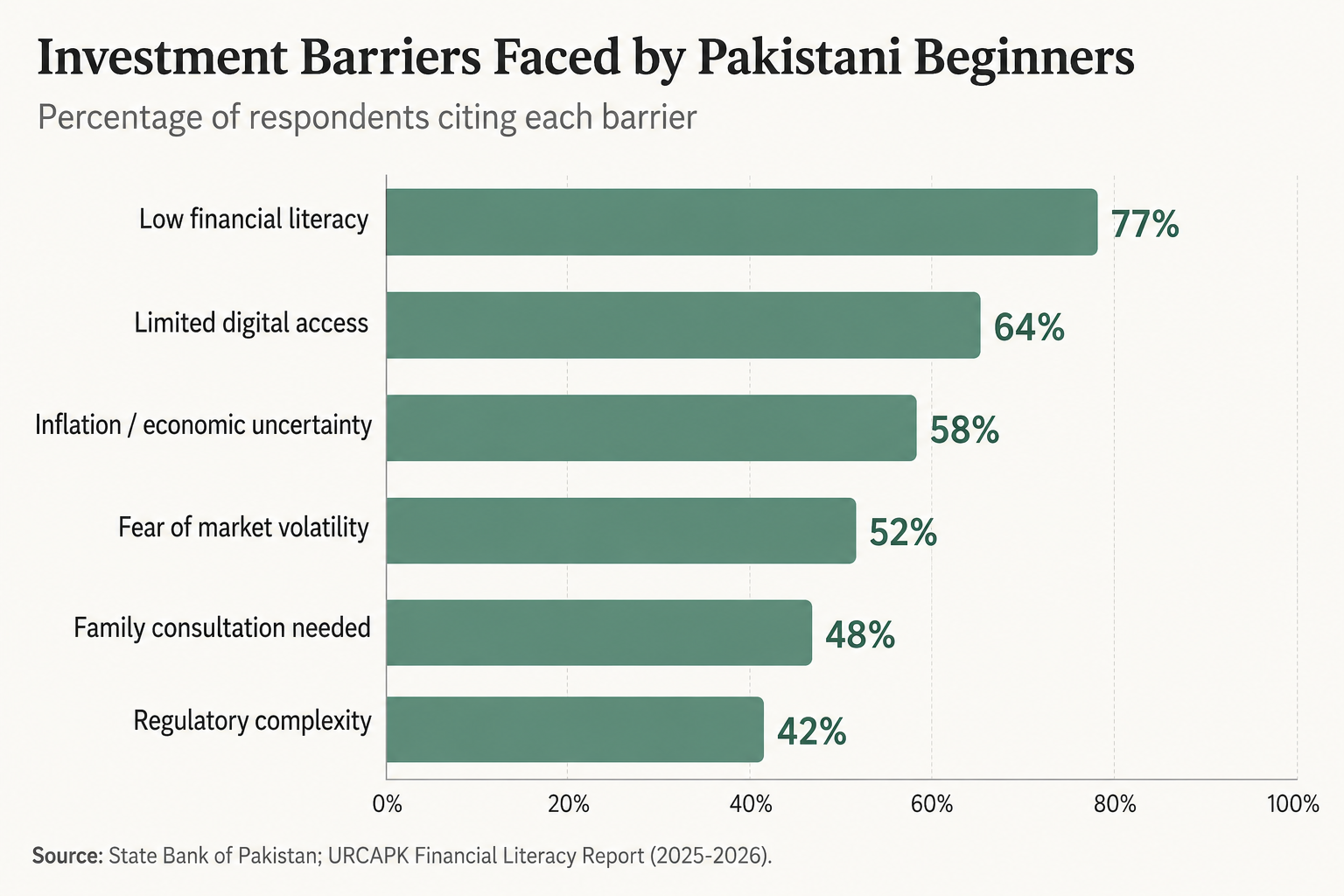
77% of Pakistani adults lack basic financial literacy (URCAPK Financial Literacy Report, 2025). That's not a judgment. That's context. Financial education simply isn't taught in schools, and family advice comes from people who grew up in different economic conditions.
The psychological weight of this gap is real. There's shame in not knowing—a quiet, private shame that keeps people from asking questions. There's also a gap between wanting to invest and actually doing it. A beginner sees the barriers (regulation complexity, fear of loss, family expectations) and chooses the safety of inaction instead.
But inaction has consequences. When inflation runs at 11.7%, a "safe" savings account becomes a wealth-eroding trap. You're not protecting money by keeping it in cash. You're losing it slowly.
This happens to nearly everyone when they start. You read one article about stocks and feel overwhelmed by terminology. You check a mutual fund platform and wonder: which one is for me? You ask yourself whether your family will support this choice. Then you close the browser and decide to "start next month."
That next month never comes, because the barriers don't shrink—your doubts do.
The first step is to name what's actually holding you back.
The Five Barriers Holding You Back (And How to Reframe Each One)
Every beginner faces similar obstacles. They're not unique to you, and they're not permanent. But they're real, and naming them is the first step to moving past them.
Barrier 1: "I Don't Understand How to Invest"
This is the loudest barrier. Financial literacy in Pakistan sits at 23% among adults overall, and only 14% among women (CoinLaw, 2026). When 77% of people feel unprepared, the majority assumes they're somehow uniquely disqualified.
Reframe: Learning takes 2-3 days of reading, not 2-3 years of study. The core concepts are simple: invest your money in vehicles that grow (stocks, mutual funds, real estate); diversify so one loss doesn't destroy you; check in regularly; adjust as needed. Everything else is detail.
Barrier 2: "It's Too Risky"
You hear stories of people losing money. The Pakistani Stock Exchange had a downturn in 2023. The rupee devalued. You imagine investing Rs 100,000 and watching it become Rs 50,000, and the shame of having "wasted" money that your family needed.
Reframe: Risk is real, but unmanaged risk (like inflation eroding your cash) is worse. The PSX returned 50% in 2025 and delivered an average of 12–18% annually over the long term (KASB, 2025). Yes, there are down years. But over a 5-10 year horizon, diversified investing historically beats inflation. The riskiest choice is staying in cash.
Barrier 3: "I Don't Have Enough Money"
You think you need Rs 1 lakh to start. So you wait until you've saved a lakh, then you wait a bit more, then life happens and that lakh gets spent.
Reframe: Mutual funds accept investments as low as Rs 5,000. The PSX requires slightly more (check your broker), and digital gold starts at Rs 100. You don't need to be rich. You need to start small and build discipline. Monthly contributions of Rs 5,000 compound. Waiting for the perfect amount compounds nothing.
Barrier 4: "I Need to Ask My Family First"
In Pakistani families, financial decisions often involve consultation—especially for younger family members or women. You may fear judgment, resistance, or a lengthy explanation about why "real estate is the only real investment."
Reframe: Consultation is wise. Deference is not. Come prepared with data: the 11.7% inflation spike, the PSX's 50% return last year, the Virtual Assets Act's regulatory clarity. Show, don't tell. Frame it not as choosing between family advice and your own, but as adding one more tool to the family's investment toolkit.
Barrier 5: "The Economy Is Unstable"
Pakistan faces terrorism concerns, political volatility, and currency fluctuations. Why invest when the whole system feels shaky?
Reframe: These factors are real, and they're already priced into returns. The PSX grew despite these headwinds. Mutual funds are managed by professionals who navigate this environment daily. Moreover, sitting in cash doesn't make you safer—inflation still eats your wealth, and you've surrendered the upside that others capture. Diversification (stocks, mutual funds, digital assets) is actually how you hedge instability.
The barriers are real. But they're not permanent. And they're almost never as large as they feel at the moment of decision.
Why Now Is Actually the Right Time
There's a psychological trap called "the perfect moment fallacy." You'll start investing when interest rates drop, when inflation stabilizes, when the economy settles, when you've saved more, when your family agrees, when the PSX hits a certain level. The perfect moment arrives only in hindsight.
But there are three tangible reasons to start now—not eventually.
Reason 1: Inflation Is Accelerating, and Inaction Is Costly
In December 2025, inflation was 5.6%. By May 2026, it jumped to 11.7%—a two-fold increase in five months (State Bank of Pakistan, 2026). The policy rate sits at 11.5%, so a good savings account might offer around 8%. Against 11.7% inflation you're still losing roughly 3-4% annually in real purchasing power, and money kept as cash loses the full amount.
Quick math: If you have Rs 1 lakh earning 8% in a savings account, you earn Rs 8,000. But inflation erodes about Rs 11,700 of buying power. You're still losing close to Rs 3,700 in real value per year, and the full Rs 11,700 if it sits as cash.
Compare that to long-term investing. The PSX averaged 12–18% annually. A mutual fund might return 9–12%. Even after inflation, you're protecting and growing wealth, not eroding it.
Start now because waiting amplifies the cost of delay.
Reason 2: New Investors Are Entering the Market—Momentum Is Real
In April 2026 alone, the Pakistan Stock Exchange added 25,114 new investor accounts. Over the full year 2025, the PSX added 120,000 new investors (Pakistan Stock Exchange, 2026). This is the fastest growth in retail participation in years.
Why does this matter? Because markets move on momentum, psychology, and availability. When institutions, media, and peer networks all point toward investing, barriers lower. The infrastructure improves (better apps, clearer regulations, more educational content). You're not early. But you're not late either. You're joining a cohort that makes the journey easier by sheer volume.
Reason 3: Regulatory Clarity Has Arrived
In March 2026, Pakistan passed the Virtual Assets Regulation Act (PVARA), establishing the Pakistan Virtual Assets Regulatory Authority. For the first time, crypto and digital assets have a legal framework. Pakistan ranks 3rd globally in crypto adoption, with 27.1 million users and $25 billion in transaction volume (Chainalysis, 2025).
This regulatory clarity means digital gold and cryptocurrency investments are no longer a gray area. They're legitimate, taxed, and monitored. That removes a major barrier to diversification for investors who see fiat currency risk and want a hedge.
Your 6-Step Roadmap to Starting (What to Do This Week)
This is the part where most guides lose you with theory. Let's be practical.
You have one week. Here's exactly what to do each day.
Step 1: Build Your Financial Picture (Days 1-2: 2 hours total)
You can't invest wisely without knowing where you stand. Spend 30 minutes answering these questions:
- Monthly income (salary, freelance, business, family support)
- Monthly expenses (rent, food, transport, utilities, subscriptions)
- Current savings (bank balance, cash at home, gold, real estate value)
- Debt (loans, credit cards, family money owed)
- Financial goals (buy a house, build Rs 10 lakh emergency fund, retire at 50)
Write these down. Seriously. Numbers on paper are more real than numbers in your head.
From this, calculate: How much can you invest monthly without breaking your budget? Start there. Even Rs 2,000/month compounds meaningfully over a decade.
Step 2: Assess Your Risk Tolerance (Days 1-2: 1 hour)
Risk tolerance isn't about how brave you are. It's about how much loss you can emotionally handle without panic-selling.
Ask yourself:
- If you invested Rs 100,000 and it dropped to Rs 80,000 tomorrow, would you hold or sell?
- Can you leave money invested for 5+ years without needing access?
- Do you sleep better knowing your money is safe (even if it loses to inflation) or growing (with short-term volatility)?
Your answers determine your mix:
- High risk tolerance (hold for 5+ years, can stomach volatility): 70% stocks, 30% bonds/gold
- Medium risk tolerance (need balance): 50% stocks, 50% mutual funds/bonds
- Low risk tolerance (can't handle swings): 30% stocks, 70% bonds/mutual funds/gold
This isn't final. It's a starting point.
Step 3: Choose Your First Investment Vehicle (Days 2-3: 1 hour)
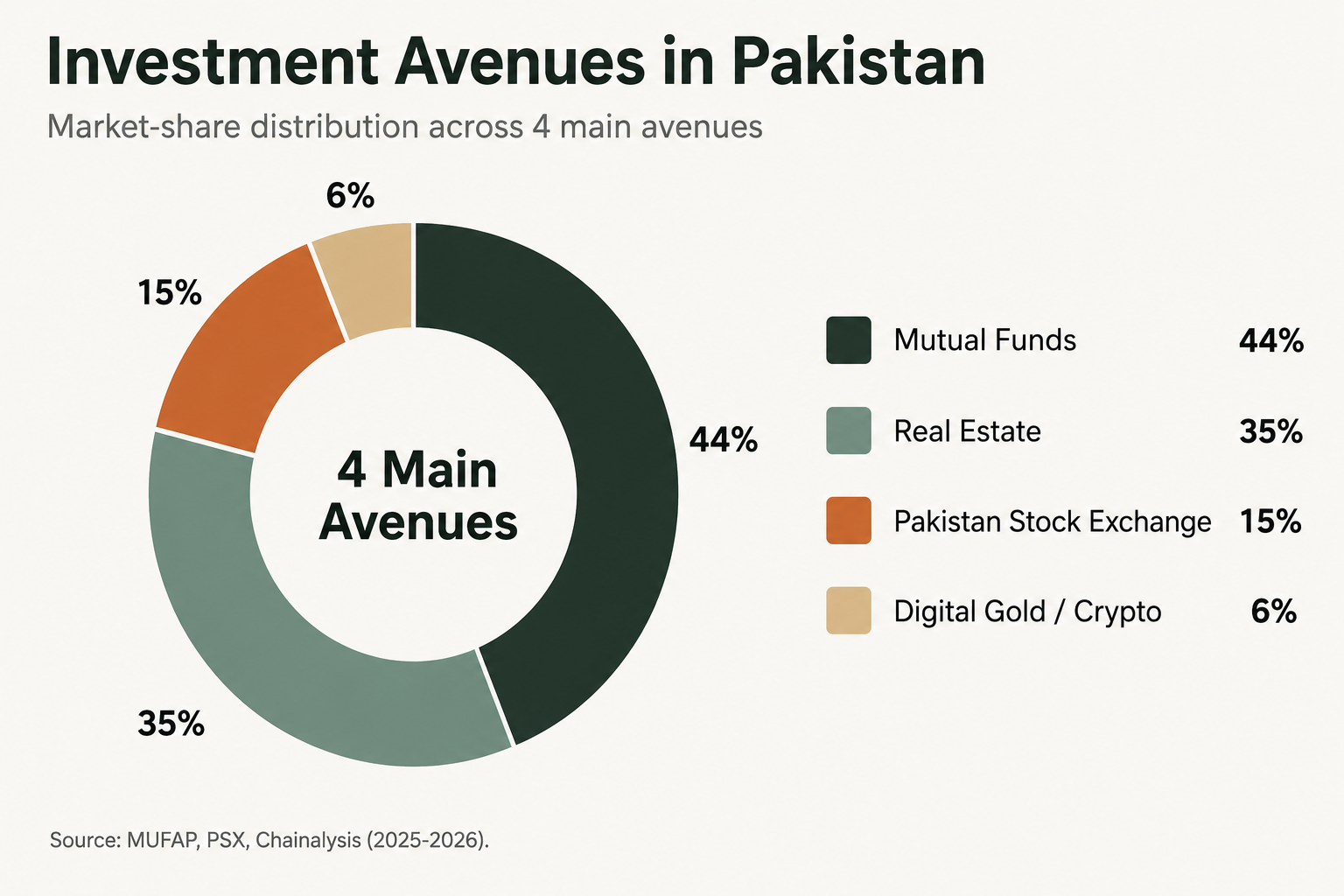
You have four main options. Choose one to start. You'll diversify later.
| Vehicle | Minimum | Expected Return | Complexity | Time to Learn |
|---|---|---|---|---|
| Mutual Funds | Rs 5,000-10,000 | 9-12% annually | Low | 2 hours |
| Pakistan Stock Exchange (PSX) | Rs 25,000-50,000 (broker dependent) | 12-18% annually | Medium | 4-6 hours |
| Digital Gold/Crypto | Rs 100-1,000 | Variable (15-25%+ historically) | Medium | 3-4 hours |
| Real Estate | Rs 500,000+ | 5% annually (current market) | High | 8+ hours |
Pick the lowest barrier first. Mutual funds. Start there. You can add PSX in three months.
Not sure which vehicle fits your situation? Our detailed guide on how to choose your first investment—mutual funds vs PSX vs digital gold compares real fees, minimums, and returns side by side.
Step 4: Open Your First Account (Days 3-4: 2 hours, with waiting time)
If you chose mutual funds:
-
Visit MUFAP and select any top AMC's
- Al Meezan Investments
- MCB Investments
- HBL Asset Management
-
Download their fund fact sheets. Read the past 3-year returns and fund objectives.
-
Start with a balanced or income fund (less volatile than equity-only funds). The industry average is Rs 3.93 trillion in AUM across mutual funds—your money will be professionally managed.
-
Complete the KYC (Know Your Customer) form online. Bring CNIC and a recent utility bill.
-
Transfer your first investment via bank account. Many funds now allow app-based transfers.
If you chose the PSX:
-
Choose a licensed broker from PSX Website:
- JS Global
- Arif Habib
- Iqbal Securities
- Topline Securities
-
Complete KYC and fund your brokerage account.
-
You're now ready to buy stocks. Start with 2-3 blue-chip companies (large, stable) rather than trying to pick winners.
If you chose digital gold/crypto:
- Choose a regulated platform. Check the PVARA-registered list.
- Platforms like Zameen, Naya Paisa, or Alif Wealth allow Pakistanis to invest in digital gold.
- Crypto platforms like Binance, Bybit require Tier 2 verification (biometric + address).
- Start with digital gold (lower volatility) before moving to crypto.
Step 5: Make Your First Investment (Days 4-5: 1 transaction)
This is the moment that matters most. Not the biggest investment—the first one.
Transfer Rs 5,000-10,000 to your fund, brokerage, or digital account. That's it. One transaction. You're now an investor.
Your mind will tell you to wait, research more, ask more people. Ignore it. You've already researched enough. Perfectionism is just fear in disguise.
Step 6: Set Up Monitoring and Automate (Days 5-7: 1 hour)
Don't check your balance daily. Markets fluctuate. Daily checking triggers emotional decisions.
Instead:
- Set a calendar reminder: "Check investment performance" for the first day of each month
- Set up automatic monthly transfers from your salary account to your investment account. This removes decision fatigue and builds discipline.
- Track three metrics: total invested, current value, and percentage gain/loss. That's enough.
Investment Avenues Explained: Which One Should You Actually Choose?
You now have four main vehicles. Let's go deeper into each one so you can decide.
Mutual Funds: The Beginner's Best Friend
The basic idea: You pool money with thousands of other investors. A professional fund manager invests that pool in stocks, bonds, or a mix. You own a piece of that pool's returns.
Why it's beginner-friendly:
- Minimum investment: Rs 5,000-10,000
- Instant diversification: One fund might hold 40+ stocks
- Professional management: You're not picking individual stocks
- Easy to understand returns: See your gain/loss in one number
What to expect:
Pakistan's mutual fund industry manages Rs 3.93 trillion in assets (Mutual Funds Association of Pakistan, 2025). The average balanced fund returned 12-15% annually over the past 5 years. Islamic funds (44% of industry) are available if Sharia compliance matters to you.
Where to start:
Choose a balanced fund from a reputable house (JS Global, Meezan, HBL). Balanced funds hold a mix of stocks and bonds, reducing volatility compared to pure equity funds.
When mutual funds are right for you:
- You're completely new to investing
- You want professional management
- You prefer lower monitoring time
- You like knowing your money is diversified
Pakistan Stock Exchange (PSX): Direct Ownership, Higher Growth
The basic idea: You buy shares of specific companies. You own a piece of that company. If it does well, the share price rises. You can also earn dividends (cash payouts).
Why it matters now:
The PSX returned roughly 50% in 2025 (including dividends). The KSE-100 index rose from 40,000 in 2020 to 80,000+ by 2025. Over a 5-year horizon, a diversified portfolio of blue-chip stocks delivers 12–18% annually.
What to expect:
You'll see daily price fluctuations. On some days, your stock might drop 2-3%. Don't panic. Over a 5-year hold, short-term swings flatten out.
Where to start:
- Open a brokerage account (JS Global, Arif Habib, etc.)
- Start with established, large companies (blue-chips): Pakistan Petroleum, PTCL, United Breweries, TRG Pakistan, Rafhan Maize
- Use the rule: Don't put all your money into one stock. Buy 3-4 different companies
When the PSX is right for you:
- You're comfortable researching companies
- You have 3-5+ years to hold your investment
- You want higher growth potential (accepting more volatility)
- You want to feel ownership in Pakistan's business ecosystem
Digital Gold: The Future-Proof Hedge
The basic idea:
Digital Gold is a digital certificate backed by physical gold stored in vaults. It moves with gold prices globally, hedging currency devaluation.
What to expect:
Digital gold: Moves with global gold prices. Lower volatility than crypto. Returns 4-8% annually depending on global trends.
Where to start:
- Digital gold platforms: Zameen, Naya Paisa (easy, low entry)
Start with digital gold if you're new. Move to crypto once you understand the volatility.
Real Estate: The Traditional Alternative (With Caveats)
The basic idea: Buy property, wait for appreciation, earn rental income.
The reality in 2026: Real estate returns in Pakistan's prime areas have slowed. Properties purchased in 2020 have appreciated only 5% by 2025—far below stock market returns (KASB, 2025). Meanwhile, transaction costs, property taxes, and regulatory uncertainty have increased.
For most beginners, real estate is not the first step. It requires Rs 500,000+ capital, ties up money for years, and demands active management (repairs, tenants, paperwork).
Emerging alternative: Real Estate Investment Trusts (REITs) allow you to invest in real estate with just Rs 10,000-50,000 (like a mutual fund for property). This is worth exploring after your first 6 months of stock or mutual fund investing.
The Psychology Behind Your Investment Decisions
Here's what most guides skip: your mind will sabotage you.
You'll feel anxiety when the market drops 5%. Your savings account earned nothing, but at least it was stable. Investing means watching numbers move. That movement triggers fear.
You'll feel regret when you see a stock you almost bought triple in value. You'll feel foolish for not knowing more before starting. You'll feel pressure from family members who warn against "speculation."
These are normal. They're not signs you're doing something wrong. They're signs you're doing something that matters.
In fact, behavioral finance researchers have found that your emotional relationship with money often trumps your rational understanding of it. Your beliefs about wealth—learned from your parents, your culture, your religion—shape your decisions more than logic does. (We explore this in depth in the psychology of money.)
Some of these beliefs serve you:
- "Save for rainy days" keeps you prepared
- "Don't gamble what you can't afford to lose" protects against ruin
- "Diversify" hedges risk
Other beliefs sabotage you:
- "Rich people are greedy" keeps you poor
- "Investing is for the wealthy" keeps you uninvested
- "I should ask permission" delays your decisions
Your task: Identify which beliefs are helping and which are hurting. Then decide consciously, not automatically.
One final reframe: Starting to invest isn't selfish. It's the opposite. When you build wealth, you have the capacity to support family, handle emergencies, and contribute to your community. Staying broke doesn't make you generous—it makes you vulnerable.
Once you start, the next challenge is avoiding the emotional traps that derail most beginners. Read the common investment mistakes Pakistani beginners make before your first market dip.
Frequently Asked Questions
Q: How much money do I actually need to start?
A: Rs 5,000-10,000 for mutual funds. Rs 100 for digital gold. Some brokers offer PSX accounts for Rs 25,000. You genuinely don't need much. The barrier is not capital. It's starting.
Q: What if the market crashes right after I invest?
A: Markets crash. That's normal. If you're investing for 5+ years, a crash is actually an opportunity—prices are lower, so your future contributions buy more shares. The PSX had significant corrections in 2023 but recovered fully by 2025. Don't panic-sell during downturns.
Q: Is investing haram? Can I find halal investment options?
A: Yes. Pakistan's mutual fund industry includes 44% Islamic funds explicitly structured to meet Sharia requirements. The PSX lists Islamic equity indexes. These aren't labeled "halal" because no uncertified fund uses that word—but genuinely Sharia-compliant products exist. Research the fund's methodology and ask your Islamic scholar if needed.
Q: My family thinks investing is risky. How do I convince them?
A: Don't convince. Show. Bring data: the 11.7% inflation, the PSX's 50% return in 2025, your conservative mutual fund choice. Frame it as protection, not speculation. Invite them to review your fund choice. Often, family concern softens when they see you've thought it through.
Q: How often should I check my investment balance?
A: Monthly. Not daily. Daily monitoring triggers emotional decisions (sell when down, buy when up—the opposite of what works). Set a calendar reminder for the first of each month, review once, and move on.
Q: How much should I invest if I'm also paying for other expenses?
A: Only invest what you won't need for 5+ years. If you're saving for a car in 2 years, don't invest that money—keep it in cash. If this is money beyond your emergency fund and immediate needs, invest it. A good rule: after you've saved 3-6 months of expenses in an emergency fund, invest excess income.
Your Next Steps: Starting Is the Hardest Part
You've read this far. You know the barriers. You know the vehicles. You know the math (inflation is eroding you now).
Starting is hardest because you can't do it perfectly. You'll choose a mutual fund and later wish you'd chosen a different one. You'll invest Rs 10,000 and think, "Should it have been Rs 15,000?" You'll watch a stock rise and think, "Why didn't I buy more?"
That's normal. So is this: you'll also build momentum. Your first investment becomes your second. Your second becomes a system. Within 12 months, you'll have contributed 12 monthly investments and your portfolio will have likely grown despite market fluctuations.
You won't become rich from your first Rs 10,000 investment. But you will become an investor. You'll join the 120,000 people who decided to act in 2025 instead of waiting. You'll stop being held back by inaction.
This week, choose one of these:
- Visit a mutual fund website and download a fact sheet.
- Open a PSX brokerage account.
- Research digital gold platforms.
Then—and this is the real step—transfer your first amount. Not next month. This week.
The best investment you've ever made will be the one you start today.
Sources
- State Bank of Pakistan. (2026). "Economic Data." Retrieved June 5, 2026, from https://www.sbp.org.pk/ecodata/index2.asp
- Pakistan Stock Exchange. (2026). "Investor Account Growth Report." Retrieved June 5, 2026, from https://www.psx.com.pk/
- Chainalysis. (2025). "2025 Global Crypto Adoption Index." Retrieved 2025, from https://www.chainalysis.com/blog/2025-global-crypto-adoption-index/
- Mutual Funds Association of Pakistan (MUFAP). (2025). "Industry Assets Under Management." Retrieved August 2025, from https://www.mufap.org.pk/
- URCAPK. (2025). "Financial Literacy Report: Pakistan." Retrieved 2025, from https://urcapk.com/
- CoinLaw. (2026). "Financial Literacy Statistics." Retrieved June 2026, from https://coinlaw.io/financial-literacy-statistics/
- Ministry of Finance Pakistan. (2025). "Economic Survey 2024-25." Retrieved June 2025, from https://www.finance.gov.pk/survey_2025.html
- Business Recorder. (2026). "Pakistan's Inflation Reaches 11.7% in May 2026." Retrieved June 2, 2026, from https://www.brecorder.com/
- KASB Securities. (2025). "Real Estate vs. Stock Market Returns Analysis." Retrieved 2025, from https://kasb.com/stocks-vs-real-estate/