
What Is Compounding, and Why Does It Matter So Much for Your Money?
Compounding is your returns earning returns. At a 12% return, money doubles every 6 yearsand starting early beats starting big. Here's how it works.
Compounding is when your investment returns start earning returns of their own. Instead of growing in a straight line, your money grows on top of its own growth: slowly at first, then dramatically. At the KSE-100's long-run average of about 12% a year, money roughly doubles every six years (Trading Economics, 2026).
It's the closest thing to magic in personal finance, except it isn't magic. It's arithmetic, plus patience. Once you understand it, you'll see why "start early" is the most valuable money advice anyone can give you.
Key Takeaways
- Compounding means earning returns on your past returns. Over decades, most of your wealth comes from growth, not from the money you put in.
- The Rule of 72: divide 72 by your annual return to estimate the doubling time. At 12% (the KSE-100's long-run average), money doubles about every 6 years (Trading Economics, 2026).
- Starting early beats starting big. A 25-year-old can finish three times richer than a 35-year-old investing the same amount, purely from extra years of compounding.
Every rupee figure in this article is an illustration based on an assumed 12% annual return (the KSE-100's long-run historical average). These are not projections, advice, or promised returns — markets rise and fall, and your actual results will differ.
What is compounding, in plain terms?
Compounding is growth feeding on growth. In year one, you earn a return on your money. In year two, you earn a return on your money plus last year's return. Each year, the base that earns returns gets bigger, so the growth accelerates.
Picture a snowball rolling downhill. It starts small, but every turn adds a layer, and each layer makes the next turn pick up even more snow. Your money works the same way once returns are reinvested rather than spent.
Here's Rs 100,000 growing at 12% a year:
- After year 1: Rs 112,000 (you earned Rs 12,000)
- After year 2: Rs 125,440 (you earned Rs 13,440, more than last year)
- After year 3: Rs 140,493
- After year 6: about Rs 197,000, nearly double
- After year 12: about Rs 389,000, nearly four times
Notice that you never added a single rupee after the first. The money grew itself, faster each year, because the returns stayed invested and started earning their own returns.
Why does compounding feel slow at first?
Because the early years are quiet, and the magic is back-loaded. For the first few years, compounding looks almost disappointing. The numbers creep. Many people give up here, convinced it isn't working. Then the curve bends upward, and the later years deliver gains that dwarf everything before them.
This is the trap that keeps Pakistanis in cash. Compounding's rewards arrive late, but our impatience arrives early. We judge investing by its first year or two, exactly the period when it looks least impressive, and quit before the part that matters. The investors who win aren't smarter. They simply stayed long enough to reach the steep part of the curve.
That patience is hard partly because of how our minds work, which we explore in the psychology of money. The discipline to leave compounding alone is worth more than any clever stock pick.
How fast does money double? The Rule of 72
Divide 72 by your annual return, and you get the rough number of years for your money to double. It's a back-of-the-envelope trick, but it's remarkably close, and it shows instantly why the rate you earn matters so much.
| Where your money sits | Annual return | Years to double |
|---|---|---|
| Cash at home / committee | ~0% | Never |
| Savings account | ~8% | ~9 years |
| Term deposit | ~10.5% | ~7 years |
| KSE-100 long-run average | ~12% | ~6 years |
| Strong equity years | ~15% | ~5 years |
The difference between 8% and 12% doesn't sound like much. But over 30 years, money doubling every 6 years (12%) goes through five doublings, while money doubling every 9 years (8%) manages just over three. That gap is the difference between comfort and wealth.
Why starting early beats starting big
A few extra years at the start are worth more than a much larger amount later, because those early rupees compound the longest. Consider three people, each investing Rs 10,000 a month at 12% until age 60, but starting at different ages:
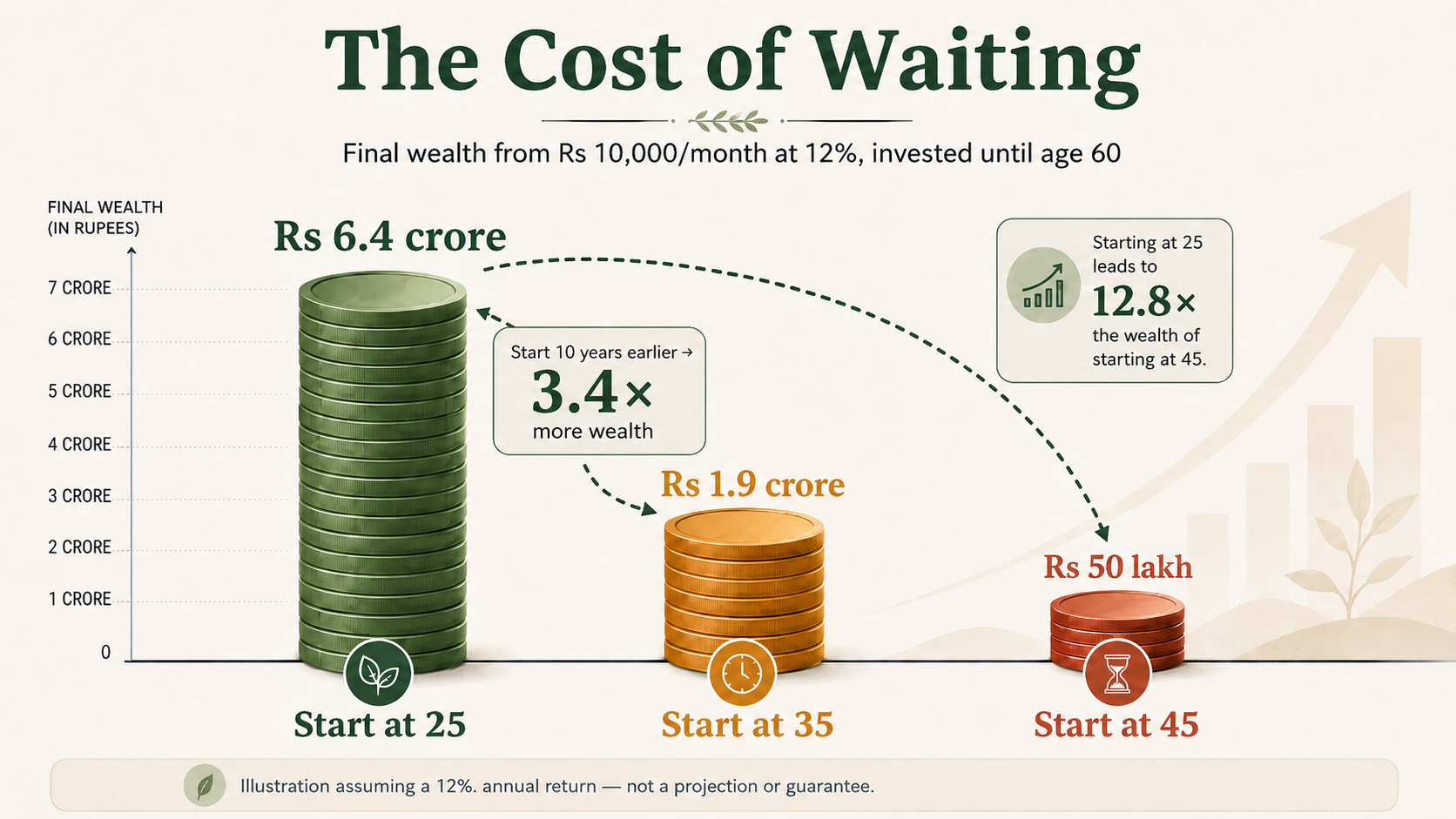
The person who starts at 25 contributes around Rs 42 lakh of their own money over the years and ends near Rs 6.4 crore. The one who starts at 45 contributes Rs 18 lakh and ends near Rs 50 lakh. The head start does the heavy lifting, not the deposits.
How do you put compounding to work in Pakistan?
Three habits, and time does the rest. Compounding rewards behaviour more than brilliance, and the behaviours are simple enough that anyone can follow them.
- Start now, with any amount. The best day was years ago; the second best is today.
- Reinvest your returns. Choose growth or accumulation options so profits stay invested and compound, rather than being paid out and spent.
- Stay consistent and patient. Invest monthly, ignore the dips, and give the curve time to bend.
If you haven't begun, see how much money you really need to start, then follow the full roadmap to start investing in Pakistan. The sooner you start, the more of the curve you get to keep.
Frequently Asked Questions
What is compounding in simple words?
Compounding is when your returns earn returns of their own. Your money grows on top of its past growth, so it speeds up over time. At a 12% annual return, money roughly doubles every six years, even if you never add more (Trading Economics, 2026).
What is the Rule of 72?
The Rule of 72 estimates how long money takes to double: divide 72 by your annual return. At 8% it's about 9 years, at 12% about 6 years. It's a quick way to see why a higher return, compounded over time, makes such a large difference.
Why does starting early matter so much?
Because early money compounds the longest. Investing Rs 10,000 a month from age 25 can grow to about Rs 6.4 crore by 60, versus about Rs 1.9 crore if you start at 35. Ten extra years more than triples the result, purely through compounding.
Does compounding work with small amounts?
Yes. Compounding cares about time and consistency, not size. Rs 5,000 a month at 12% grows past Rs 11 lakh in 10 years and near Rs 50 lakh in 20. Small, regular investing beats large, occasional investing for most people.
How do I make sure my investments compound?
Reinvest your returns instead of withdrawing them. Choose growth or accumulation fund options, keep your money invested for 5+ years, and avoid selling during dips. Compounding only works when returns stay in the pot long enough to grow on themselves.
The bottom line
Compounding is the quiet force that turns ordinary savers into wealthy ones. It asks for almost nothing except time and patience, and it punishes nothing as harshly as delay.
You can't control the market's return in any single year. You can control when you start and how long you stay. Those two choices, made well, do more for your future than chasing the perfect investment ever will.
Start the snowball today. Here's how to take the first step.
Sources
- Trading Economics. "Pakistan Stock Market (KSE-100) — Returns and Historical Data." Retrieved 2026-06-11, from https://tradingeconomics.com/pakistan/stock-market
- State Bank of Pakistan / Pakistan Bureau of Statistics, via Business Recorder. "Pakistan inflation hits 11.7% in May 2026." Retrieved 2026-06-11, from https://www.brecorder.com/news/amp/40423444
- Mutual Funds Association of Pakistan (MUFAP). "Industry Assets Under Management." 2025. Retrieved 2026-06-11, from https://www.mufap.org.pk/
- Securities and Exchange Commission of Pakistan (SECP). "Investor education: the power of compounding." 2025. Retrieved 2026-06-11, from https://www.secp.gov.pk/