
Income Tax in Pakistan 2026-27: A Complete Guide to the New Slabs and Filing Your Return
The FY2026-27 budget cut salaried tax rates and scrapped the surcharge. Here are the new slabs, a clear comparison with last year, and how to file your return on IRIS.

Pakistan's FY2026-27 budget cut income tax rates for the salaried middle and upper-middle class and abolished the 9% surcharge on high salaries. The new rates take effect on 1 July 2026 (Tax Year 2027). But the return you file this season due 30 September 2026 is for Tax Year 2026, under last year's rates. This guide separates the two and walks you through both.
Tax season trips up first-time filers for one simple reason: the rules you file under and the rules you hear about in the budget belong to different years. Get that distinction right and the rest is process. Here are the new slabs, an honest comparison with last year, and a step-by-step path to filing on FBR's IRIS portal.
Key Takeaways
- From 1 July 2026 (Tax Year 2027), salaried tax rates fell in four income bands — the Rs 2.2–3.2m band dropped from 23% to 20%, and the 9% surcharge on incomes above Rs 10m was abolished entirely (Express Tribune, 2026).
- The Rs 600,000 annual exemption is unchanged, and anyone earning up to Rs 2.2m a year (~Rs 183,000/month) sees no rate change at all (FBR, 2026).
- The return due 30 September 2026 is for Tax Year 2026 (income earned July 2025–June 2026). Filing late costs Rs 1,000+ per day and drops you off the Active Taxpayer List (FBR; PwC, 2026).
Worked rupee figures below are illustrations to show how the slabs apply. Tax depends on your exact taxable income and allowances — check yours with our Salary Tax Calculator 2026-27, or a tax adviser, before filing.
First, which year are you actually filing?
This is the single biggest source of confusion, so let's settle it up front. "FY2026-27" (Tax Year 2027) is the year that starts 1 July 2026 its new, lower rates apply to the salary you earn from that date, and you'll file that return by 30 September 2027. The return most people are filing right now, by 30 September 2026, is Tax Year 2026: income earned between 1 July 2025 and 30 June 2026, taxed under the old rates.
In short: the budget headlines are about next year's money; this season's return is about last year's. Both matter the new slabs tell you what your take-home will look like from July, and the filing process is the same either way. We'll cover the new rates first (because that's the news), then the filing mechanics (because that's the deadline).
Pakistan's fiscal year always runs 1 July to 30 June, and the Finance Act passed each June sets the rates for the year ahead.
What are the new FY2026-27 income tax slabs for salaried people?
For Tax Year 2027, rates were cut in four salaried income bands and left unchanged for everyone earning up to Rs 2.2 million a year. The basic exemption stays at Rs 600,000. The headline relief: the Rs 2.2–3.2m band fell from 23% to 20%, and the band from Rs 4.1–5.6m fell from 35% to 29% (FBR Budget 2026-27; PwC Tax Memorandum on Finance Bill 2026, 2026).
Here is the full salaried slab table for Tax Year 2027, with last year's rate beside it so you can see exactly what changed:
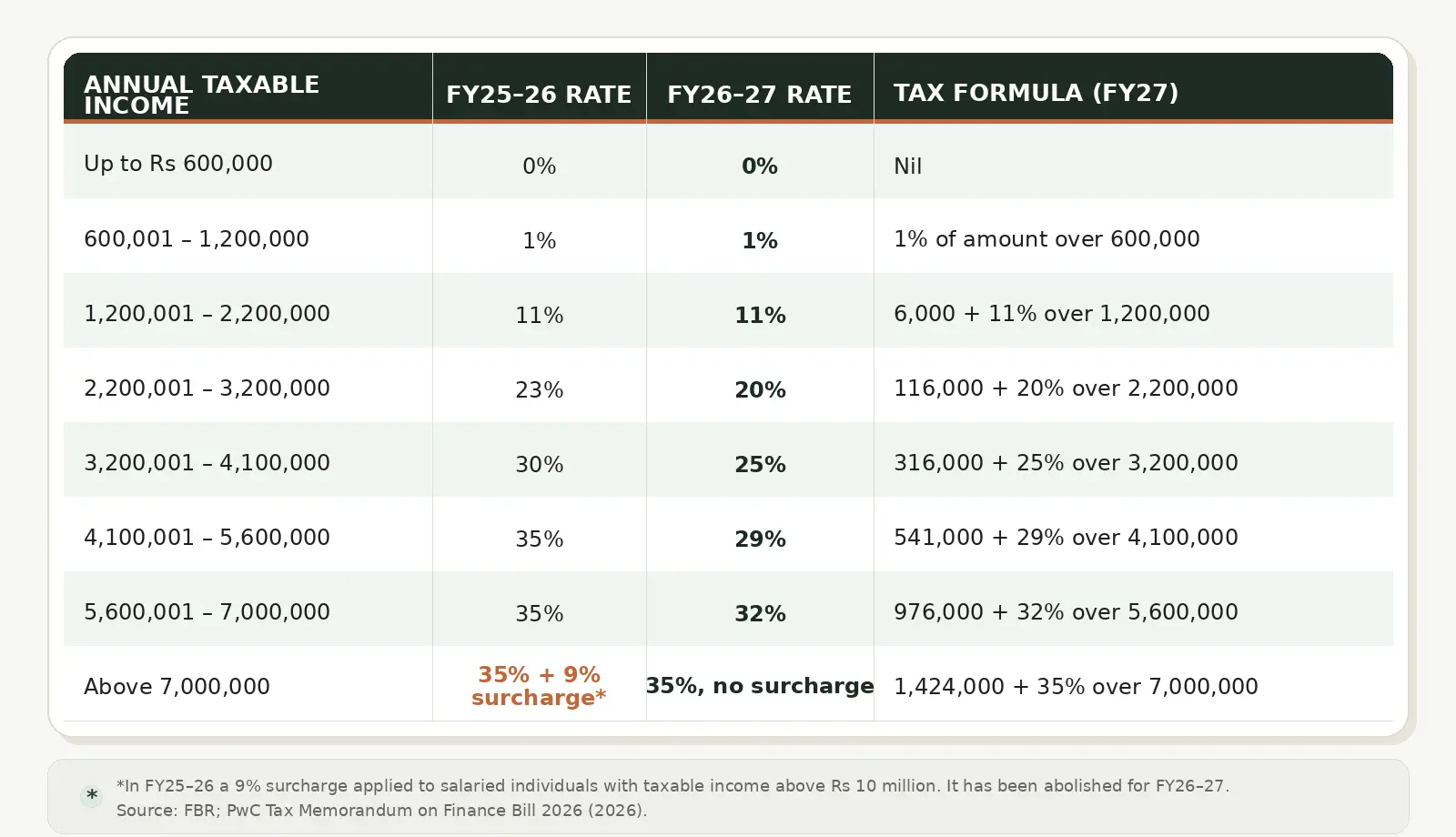
*In FY25-26 a 9% surcharge applied to salaried individuals with taxable income above Rs 10 million. It has been abolished for FY26-27. Source: FBR; PwC Tax Memorandum on Finance Bill 2026 (2026).
Two things stand out. First, nothing changed below Rs 2.2 million if you earn under about Rs 183,000 a month, your rate is the same as last year. Second, the cuts get bigger as income rises, and the surcharge removal hands the most to those above Rs 10 million.
How much will the new rates actually save you?
For most middle-income earners, the saving is modest; for higher salaries, it's meaningful. Someone on Rs 3 million a year (Rs 250,000/month) saves about Rs 24,000 for the year, while someone on Rs 6 million saves close to Rs 177,000 — before counting the scrapped surcharge (illustrative, based on the slab table above).
Let's make it concrete with three salaried examples. These are illustrations using the slabs above, assuming the whole amount is taxable salary with no extra allowances:
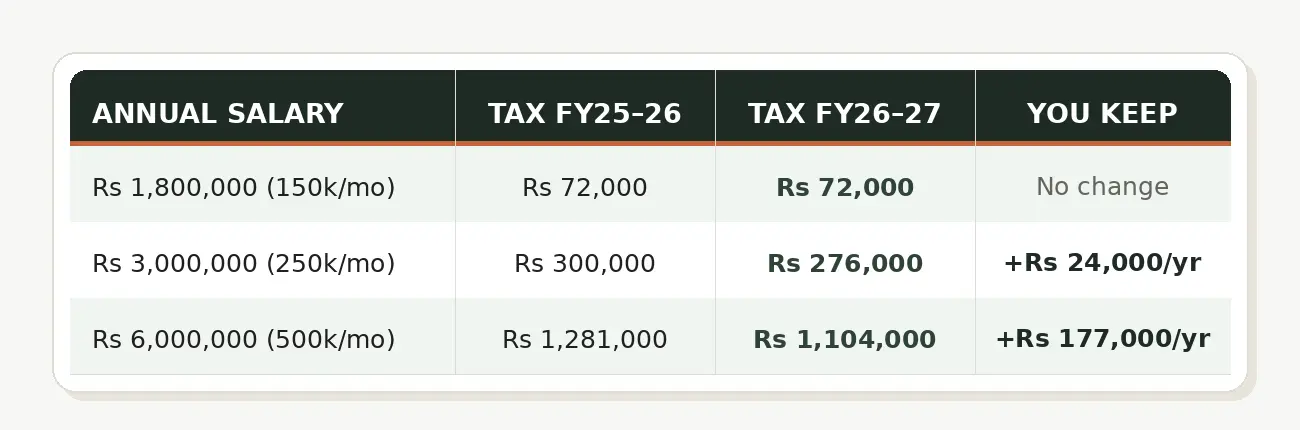
Want your exact figure? Skip the manual math — run your monthly salary through Pebble's Salary Tax Calculator for 2026-27. It applies the slabs above automatically and shows your tax in seconds.
Here's the part worth pausing on: the saving isn't spending money — it's a head start. The Rs 24,000 a year a mid-salary earner keeps is roughly Rs 2,000 a month. Invested steadily rather than absorbed into spending, that's exactly the kind of small, automatic amount that compounds over years. A tax cut quietly handed back is the easiest "raise" you'll ever get to redirect toward your future self. If you want a place to start, see how to start investing in Pakistan.
Beyond salaries, the budget also abolished super tax for incomes up to Rs 500 million and cut it from 10% to 8% above that, and announced a 7% raise for federal government employees and pensioners (FBR, 2026). Business individuals and AOPs are taxed on a different slab schedule — this guide focuses on salaried filers.
Why filing matters: filer vs non-filer
Filing isn't just a legal duty — it's the difference between paying normal tax and paying a penalty rate on everyday transactions. A non-filer in Pakistan pays two to four times more withholding tax on things like property, bank profit, and dividends, simply for not being on the Active Taxpayer List (ATL) (Akbar Tax Store, 2026).
The Active Taxpayer List (ATL) is FBR's public list of people who've filed their return. Once you file, your name appears on it (the list updates every week), and you unlock the lower "filer" withholding rates. The gap is large and very real:
- Profit on bank deposits / savings: filers pay 15%, non-filers up to 35%.
- Dividends from shares or mutual funds: filers pay the standard rate; non-filers pay sharply more.
- Property, vehicles, prize bonds, cash withdrawals: non-filers pay inflated rates across the board.
For anyone who saves or invests, this matters directly. If you earn a dividend from the PSX or a fund, or profit on a bank account, being a non-filer means the bank or AMC deducts a punitive rate before you ever see the money. Filing is the cheapest financial upgrade most Pakistanis can make.
There's also a middle category: a late filer. If you miss the deadline you can still get onto the ATL by paying a surcharge — Rs 1,000 for an individual, Rs 10,000 for an AOP, Rs 20,000 for a company — but you're flagged as "late," and you'll have spent the year as a non-filer until you pay (FBR, 2026).
How do you file your income tax return in Pakistan?
You file online through FBR's IRIS portal at iris.fbr.gov.pk, and for a typical salaried person it takes under an hour once your documents are ready. You'll need your CNIC (which doubles as your NTN), your salary certificate, and details of your bank profit, any investments, and major assets. The process is the same whether you're filing Tax Year 2026 now or a future year.
Here's the path, step by step:
- Register / log in to IRIS. First-timers register at iris.fbr.gov.pk with their CNIC and mobile number to get an NTN. Returning filers just log in.
- Open the right return. Go to Declaration → Income Tax Return → select Tax Year 2026 (the year ended 30 June 2026).
- Enter your salary income. Use your employer's salary certificate. Tax your employer already deducted (withheld) goes in the "tax already paid" section — it's credited against what you owe.
- Add other income. Bank profit, dividends, rental income, freelance or business income — each has its own field.
- Complete the wealth statement. Every resident filer must declare assets and liabilities (bank balances, property, vehicles, gold, investments). Your wealth should reconcile with your income — unexplained jumps draw questions.
- Check the auto-calculated tax. IRIS computes your liability from the slabs. If your employer withheld the right amount, your balance due is often zero.
- Pay any balance and submit. Generate a PSID for any tax due, pay via bank or app, then submit. Save the acknowledgement.
If your only income is salary and tax was fully deducted at source, you're mostly confirming numbers, not calculating from scratch. First time through, give yourself an evening and keep your documents in one folder.
IRIS says "CNIC/NTN is not found at Registration No." — what now?
This error usually means IRIS has no registration against the CNIC you typed — or the CNIC wasn't entered the way IRIS expects. It's common for first-time filers and almost always fixable in a few minutes. Work down this list:
- Type your CNIC as 13 digits, no dashes.
3520212345678, not35202-1234567-8. This alone resolves a large share of cases. - If you've never registered, the record genuinely doesn't exist yet. Use New Registration (e-Enrolment) on iris.fbr.gov.pk first — you can't log in before enrolling. Your CNIC becomes your NTN once enrolled.
- Try a fresh browser or clear cache. IRIS is picky; Chrome/Firefox with a cleared cache fixes odd behaviour.
- Filing-season server load is real. Evenings near deadlines, IRIS slows or errors. Wait and retry off-peak.
- Still stuck? Call the FBR helpline
051-111-772-772[verify — confirm current helpline number on fbr.gov.pk], or visit your Regional Tax Office (RTO) with your original CNIC.
For the full registration walk-through, see How to register on IRIS and find your NTN.
When is the last date to file your 2026 tax return?
30 September 2026 is the deadline for individuals and salaried persons filing the Tax Year 2026 return. Filing opened in July 2026. Late filing costs Rs 1,000 per day (minimum applies), plus the Rs 1,000 late-filer ATL surcharge — and non-filer withholding rates until you're back on the list.
| What | Date |
|---|---|
| Tax Year 2026 covers income earned | 1 Jul 2025 – 30 Jun 2026 |
| Filing window opens | July 2026 |
| Last date to file (individuals/salaried) | 30 September 2026 |
| ATL updates | Weekly (Sunday) |
| New FY2026-27 rates apply to salary from | 1 July 2026 (file by 30 Sep 2027) |
When is the deadline, and what happens if you miss it?
The deadline for individuals and salaried persons to file the Tax Year 2026 return is 30 September 2026. Miss it and the penalty is Rs 1,000 per day of default, subject to a minimum, and you fall off the Active Taxpayer List until you file and pay the late surcharge (FBR income tax due dates; PwC, 2026).
FBR sometimes grants short extensions, but you can't count on one — in recent years it has publicly refused blanket extensions and held the 30 September date. The safe move is to treat the deadline as firm and file in early-to-mid September, not on the last night when the portal is overloaded.
Two costs of filing late are easy to underestimate:
- The daily penalty adds up — a month late is tens of thousands of rupees in exposure.
- Losing filer status is the bigger hit. Every withholding transaction in that window is charged at the non-filer rate, which usually dwarfs the penalty itself.
File on time, and both problems simply disappear.
How are your savings and investments taxed?
Investment income has its own rules, mostly collected automatically — and being a filer keeps the rate low. Capital gains on listed securities acquired on or after 1 July 2025 are taxed at 15% for people on the ATL, while non-filers are taxed at their normal slab rates instead (or 29% for companies) (NCCPL; PwC, 2026).
A quick map of how common investments are taxed, so there are no surprises:
- Stocks & equity mutual funds: capital gains tax of 15% on units/shares acquired from 1 July 2025; for stock funds the fund deducts it at redemption. Gains are exempt if you hold longer than six years (NCCPL, 2026).
- Dividends: taxed at source, with filers paying the standard rate and non-filers paying more — another reason to file.
- Digital gold / PMEX commodities: gains on PMEX commodity contracts are taxed separately; keep your transaction records for your wealth statement. See is digital gold safe and how it's taxed.
- Bank profit & National Savings: profit is withheld at the filer or non-filer rate depending on your ATL status.
None of this should scare you off investing — most of it is deducted before the money reaches you, and the filer rates are reasonable. It just means two habits: stay on the ATL, and keep clean records of what you bought, sold, and earned. That paperwork is also what makes your annual wealth statement painless.
Frequently Asked Questions
Do I have to file a tax return if my employer already deducts tax?
Yes. Tax deducted by your employer is withholding — filing your annual return is a separate legal requirement for anyone earning above the Rs 600,000 exemption, and it's what puts you on the Active Taxpayer List. If your employer withheld the correct amount, your return may simply confirm a zero balance, but you still must file by 30 September.
What are the new income tax slabs for FY2026-27?
For Tax Year 2027 (from 1 July 2026), the exemption stays at Rs 600,000. Rates fell in four bands: Rs 2.2–3.2m to 20% (from 23%), Rs 3.2–4.1m to 25% (from 30%), Rs 4.1–5.6m to 29% (from 35%), and Rs 5.6–7m to 32%. The 9% surcharge on incomes above Rs 10m was abolished (FBR, 2026).
When is the last date to file income tax returns in Pakistan?
The deadline for individuals and salaried persons for Tax Year 2026 is 30 September 2026. Late filing carries a penalty of Rs 1,000 per day of default and removes you from the Active Taxpayer List until you file and pay the late-filer surcharge of Rs 1,000 for individuals (FBR, 2026).
What is the difference between a filer and a non-filer?
A filer appears on FBR's Active Taxpayer List because they filed their return; a non-filer does not. Non-filers pay roughly two to four times more withholding tax on property, bank profit, dividends, and cash withdrawals. Filing is the simplest way to stop overpaying on everyday transactions (Akbar Tax Store, 2026).
How do I check if I'm an active filer?
FBR publishes the Active Taxpayer List and updates it every Sunday. You can check your status by sending an SMS to 9966 with the word "ATL" followed by your CNIC (no dashes), or by searching the ATL on FBR's website. Your name appears after you file your return for the relevant tax year.
How much tax do I pay on my investments?
Capital gains on listed securities and equity mutual fund units acquired from 1 July 2025 are taxed at 15% for filers, and gains are exempt after a six-year holding period. Dividends and bank profit are withheld at source, at lower rates for filers than non-filers (NCCPL; PwC, 2026).
Is my CNIC my NTN number?
Yes — for individuals, your 13-digit CNIC works as your NTN once you're registered on IRIS. You don't get a separate number; enrolling on IRIS activates your CNIC as your tax number. Businesses and AOPs get a distinct NTN.
What is the tax card for 2026-27 in Pakistan?
The tax card is the slab table for the year: 0% up to Rs 600,000, then 1%, 11%, 20%, 25%, 29%, 32% and 35% bands, with the 35% rate now starting above Rs 7 million and no surcharge. The full table with rupee amounts is above.
What happens if IRIS says my CNIC/NTN is not found?
It usually means you haven't completed e-Enrolment yet, or the CNIC was typed with dashes. Enter it as 13 plain digits, register via New Registration if you never have, and try a cleared cache or different browser. If it persists, contact FBR's helpline or your RTO.
The bottom line
The FY2026-27 budget is genuinely good news for salaried Pakistanis: lower rates in the middle and upper bands, no more surcharge on high salaries, and an unchanged exemption that protects the lowest earners. But the relief applies to the year starting July 2026 — the return on your desk now is still Tax Year 2026.
So do two things this season. File by 30 September to stay on the Active Taxpayer List and avoid paying non-filer rates all year. And when next year's lighter tax lands in your account, treat the difference as a small, automatic raise — the kind that's perfect to invest rather than spend.
This guide explains the system in plain terms; it isn't personal tax advice. Tax depends on your exact income, allowances, and circumstances. For anything complex, confirm with FBR's resources or a registered tax adviser.
Sources
- Federal Board of Revenue (FBR). "Budget 2026-27 — Salient Features." Retrieved 2026-06-22, from https://fbr.gov.pk/Budget2026-27/SalientFeatures/Salient-Feature.pdf
- FBR. "Income Tax Due Dates." Retrieved 2026-06-22, from https://fbr.gov.pk/categ/income-tax-due-dates/51147/40846/81148
- PwC. "Tax Memorandum on the Finance Bill 2026." 13 June 2026. Retrieved 2026-06-22, from https://www.pwc.com.pk/en/Tax/Momendrum/AFF_Tax_Memorandum_on_Finance_Bill_2026.pdf
- PwC Worldwide Tax Summaries. "Pakistan — Individual — Tax administration." Retrieved 2026-06-22, from https://taxsummaries.pwc.com/pakistan/individual/tax-administration
- The Express Tribune. "Budget 2026-27: Govt cuts taxes, ends surcharge for four salaried class income slabs." June 2026. Retrieved 2026-06-22, from https://tribune.com.pk/story/2612818/budget-2026-27-govt-cuts-taxes-ends-surcharge-for-four-salaried-class-income-slabs
- National Clearing Company of Pakistan (NCCPL). "Capital Gains Tax." Retrieved 2026-06-22, from https://www.nccpl.com.pk/cgt
- Akbar Tax Store. "Filer vs Non-Filer in Pakistan — Tax Differences & Benefits (2026)." Retrieved 2026-06-22, from https://www.akbartaxstore.com/guides/filer-vs-non-filer-benefits