
What Is Digital Gold, and How Does It Work in Pakistan?
Digital gold lets you buy real, vault-backed gold from a few hundred rupees through PMEX. Here's how it works in Pakistan, what it costs, and who it suits.
Digital gold lets you buy and own real gold in tiny digital units from as little as one milli tola, a few hundred rupees without storing a single bar yourself. In Pakistan it runs mainly through PMEX, the country's only SECP-regulated commodities exchange, where the gold backing your balance sits in an approved vault. With 24K gold near Rs 435,000 per tola in June 2026, it's the most accessible way most Pakistanis can start owning gold.
Gold has been Pakistan's favourite store of value for generations. Digital gold keeps the metal but drops the friction: no locker, no making charges, no worrying whether the tola at the jeweller is really 24 karat. Here's exactly how it works, what it costs, and where it fits.
Key Takeaways
- Digital gold is real, vault-backed gold you buy in tiny units (1 milli tola = 0.011664 grams) through PMEX, Pakistan's only SECP-regulated commodities exchange.
- You can start from a few hundred rupees, sell on the exchange anytime, and take physical delivery once you hold 10 tola or more (PMEX, 2026).
- With 24K gold around Rs 435,000 per tola in June 2026, digital gold is mainly a hedge — it tracks the gold price and a falling rupee — not a high-growth investment.
What is digital gold, exactly?
Digital gold is a digital holding that represents real, physical gold stored on your behalf in a secure vault. Each unit you buy is backed by actual gold of 999.0 fineness (24 karat), held by the exchange. You own the value and the risk of that gold from the moment you buy, but you skip the storage, security, and purity headaches of keeping bars or jewellery at home.
The key word is backed. Good digital gold isn't a number in an app that merely tracks the gold price — it's a claim on specific, audited gold sitting in a vault. That difference is everything, and it's the first thing to check before you trust any platform with your money. (We cover exactly how to verify it in is digital gold safe?)
Because it's divisible into tiny units, digital gold removes gold's oldest barrier: price. A single tola costs around Rs 435,000 in 2026, out of reach for a monthly saver. One milli tola — a thousandth of a tola — costs a few hundred rupees. Same metal, same vault, a fraction of the cheque.
How does digital gold work in Pakistan?
It works through PMEX (Pakistan Mercantile Exchange), the only commodities exchange licensed and regulated by the SECP. You don't deal with PMEX directly you go through a PMEX-registered broker or app. The flow is simple:
- Open an account with a PMEX-registered broker, using your CNIC (the process is largely digital now).
- Deposit funds into your trading account.
- Buy gold in milli tola units. Gold is priced in rupees per tola of 999.0 fineness, and you can buy as little as one milli tola.
- Hold it — the physical gold backing your balance is kept in an Exchange-Approved Vault, in 10-tola bars from approved refineries.
- Sell anytime on the exchange at the live market price, or keep accumulating.
If you ever want the metal in your hands, you can. Once your balance reaches 10 tola or more, you can request physical withdrawal from the vault with about five working days' notice you just cover the delivery, storage, and insurance costs (PMEX Milli Tola Gold spec, 2026). Below 10 tola, your gold stays in the vault and you simply sell your units when you want the cash.
One honest caution: PMEX also offers leveraged gold futures (where you put down a fraction of the value and borrow the rest). That is trading, not saving — it's riskier, and it raises Shariah questions. For a savings hedge, buy gold fully paid, not on margin.
Digital gold vs physical gold: which is better?
Neither is "better" — they're the same metal with different trade-offs. Physical gold gives you something to hold; digital gold gives you accessibility, assured purity, and easy resale. For most savers building a position rupee by rupee, digital wins on practicality.
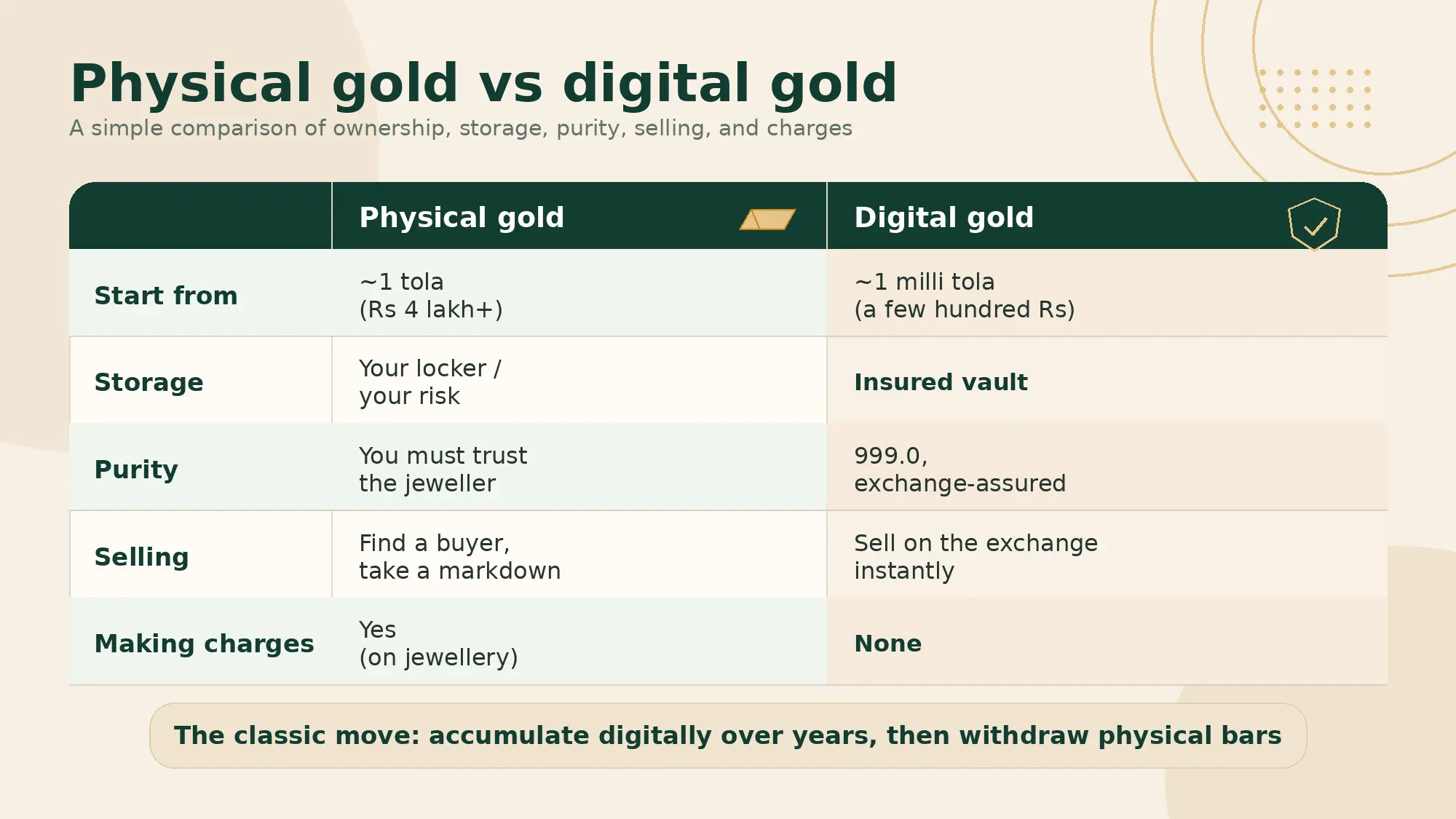
The classic move: accumulate digitally over years, then withdraw physical bars once you cross 10 tola if you want something tangible for a wedding or an heirloom. You get the discipline of small regular buying and the metal in the end.
What does digital gold actually cost?
Less than physical, but not nothing — and the honest answer matters. There are three costs to know:
- The spread — the small gap between the buy and sell price. You pay it on the way in and out, so frequent trading eats returns. Gold is a hold-for-years asset; trade it rarely.
- Vault and custody charges — storage, handling, and insurance on the gold held for you. These are modest but real, and you bear them while you hold (PMEX, 2026).
- Tax — gains on PMEX commodity contracts are taxed at 5% (NCCPL, 2026). Physical gold sold at a profit, by contrast, is added to your income and taxed at your slab rate. Keep your records.
Here's the part the jeweller won't tell you: physical gold has hidden costs too. Making charges on jewellery (often 8-20%), the dealer's buy-sell markup, and the quiet risk that your "22 karat" isn't quite 22 — these can dwarf a digital platform's transparent spread. Digital gold doesn't remove costs; it just makes them visible, which is usually cheaper.
Is digital gold right for you?
Digital gold suits you if you want a simple, low-barrier hedge — not if you're chasing high growth. Gold protects value; it doesn't compound like a business. Over the last decade it has roughly tracked the rupee's slide against the dollar, which is exactly its job: when the rupee weakens, gold (priced off the dollar) tends to rise, cushioning your purchasing power. That's why it pairs well with the case we make in how inflation quietly shrinks your savings.
Digital gold is a good fit if you:
- Want to start small and buy gold regularly, rupee by rupee.
- Want a hedge against a falling rupee and rising prices.
- Don't want the theft risk or making charges of physical gold.
- Are building a diversified mix, not betting everything on one asset.
It's a part of a portfolio, not the whole thing. A common approach is to hold some gold for safety alongside growth assets like funds or stocks. And before you buy, two questions deserve their own answers: is digital gold halal? and is digital gold safe?
Frequently Asked Questions
What is digital gold in simple words?
Digital gold is real gold you buy in tiny digital units, stored for you in a secure vault instead of at home. Each unit is backed by physical 24K gold. In Pakistan you buy it through PMEX, the only SECP-regulated commodities exchange, from as little as one milli tola.
How much money do I need to start digital gold in Pakistan?
Very little — about one milli tola, which is a few hundred rupees at the June 2026 gold price of roughly Rs 435,000 per tola. That low entry point is digital gold's biggest advantage over physical gold, where one tola costs over Rs 4 lakh.
Is digital gold backed by real gold?
With a properly regulated platform, yes. On PMEX, your balance is backed by physical gold of 999.0 fineness held in an Exchange-Approved Vault, and you can take physical delivery once you hold 10 tola or more. Always confirm a platform holds allocated, audited gold before buying.
Can I convert digital gold to physical gold?
Yes, once your holding reaches 10 tola or multiples of it. You give PMEX about five working days' notice and cover the delivery, storage, and insurance costs. Below 10 tola, you simply sell your units on the exchange for cash at the live price.
Is digital gold a good investment in Pakistan?
It's a good hedge, not a growth engine. Gold protects purchasing power when the rupee falls, but it doesn't compound like stocks or funds. Most savers hold some gold for safety alongside growth assets, rather than relying on it alone.
The bottom line
Digital gold takes Pakistan's most trusted store of value and removes its biggest barriers — price, purity doubt, and storage risk. For a few hundred rupees you can own real, vaulted, 24-karat gold, sell it in seconds, and take the bars home once you've built up enough.
It won't make you rich, and it isn't meant to. It's a hedge: a calm corner of your money that holds its worth when the rupee doesn't. Used that way — fully paid, held for years, as one part of a wider plan — it earns its place.
Sources
- Pakistan Mercantile Exchange (PMEX). "Milli Tola Gold Futures Contract Specifications." Retrieved 2026-06-14 (unit, fineness, vault, 10-tola withdrawal, costs).
- PMEX. "Pakistan's only SECP-licensed commodities exchange." Retrieved 2026-06-14, from https://pmex.com.pk/
- Gold Rate in Pakistan. "Gold rate per tola, June 2026 (~Rs 432,000–439,000, 24K)." Retrieved 2026-06-14, from https://goldrateinpakistan.pk/
- NCCPL / Profit by Pakistan Today. "Capital gains tax on PMEX commodity contracts (5%), FY26." Retrieved 2026-06-14, from https://profit.pakistantoday.com.pk/2025/08/05/nccpl-announces-revised-capital-gains-tax-rates-effective-in-fy26/