
Filer vs Non-Filer in Pakistan 2026-27: The Real Difference (and What It Costs You)
Salary tax is the same for both. The real gap is everywhere else — non-filers pay up to 2–4× more tax on bank profit, property, vehicles, and dividends.

Here is the part most people get wrong: becoming a filer does not lower the tax deducted from your monthly salary. That rate is identical whether you file or not. What being a filer changes is everything else a non-filer in Pakistan pays roughly two to four times more withholding tax on bank profit, property, vehicles, and dividends, and can't claim a refund on tax overpaid.
So if you're salaried and someone told you "don't bother filing, your tax is already deducted" — they're half right and it's costing you money. This guide lays out exactly where the filer and non-filer paths split, with rupee figures, and how to switch sides before the 30 September 2026 deadline.
Key Takeaways
- Salary tax is the same for filers and non-filers — the slabs apply to both. Filing changes the withholding rate on your other money, not your payslip (PwC, 2026).
- On profit from bank deposits, a filer pays 15% while a non-filer pays up to 35% — on Rs 100,000 of profit, that's a Rs 20,000 gap for doing nothing wrong except not filing.
- Filing puts you on the Active Taxpayer List (ATL), updated weekly. Miss the 30 September 2026 deadline and you can still join as a "late filer" by paying a Rs 1,000 surcharge (individuals) (FBR, 2026).
What is a filer, and what is a non-filer in Pakistan?
A filer is simply someone who has filed their income tax return and appears on FBR's Active Taxpayer List (ATL); a non-filer is anyone who hasn't. That single status — on the list or not — is what banks, property registrars, and car dealers check before deciding how much tax to withhold from you.
It helps to clear up two common mix-ups. Being a filer is not the same as having an NTN — for most salaried people the CNIC already works as the NTN, and registering for one doesn't make you a filer. You become a filer only when you actually file the return. And the ATL for Tax Year 2026 is built from the returns filed for that year, so filing late means you sit as a non-filer until your name is added.
The list is published by FBR and refreshed every week. Your name appears once you've filed the relevant year's return — and from that point the lower "filer" rates apply to your transactions.
Does a filer pay less tax on their salary?
No — and this is the myth worth killing first. The salary tax slabs are identical for filers and non-filers. If you earn Rs 250,000 a month, your employer withholds the same amount either way; filing your return doesn't reduce that figure by a single rupee (PwC Worldwide Tax Summaries, 2026).
This is exactly why the "my tax is already deducted, so why file?" logic feels true and is still wrong. Your salary tax is handled. But your salary isn't the only place tax touches your money — and on every other front, the non-filer pays a penalty. The relief in the FY2026-27 budget (lower slabs, surcharge abolished) also applies to both groups equally; for the full slab table, see our complete guide to the new income tax slabs and filing.
For a salaried person, then, filing isn't about your payslip. It's about stopping the quiet over-charge on your savings, your car, and your property.
Where do non-filers actually pay more?
Everywhere money moves except salary. Non-filers face inflated withholding rates on bank profit, dividends, property transactions, vehicles, prize bonds, and cash withdrawals — and unlike filers, they can't reclaim tax they overpaid. The table below is the heart of the difference:
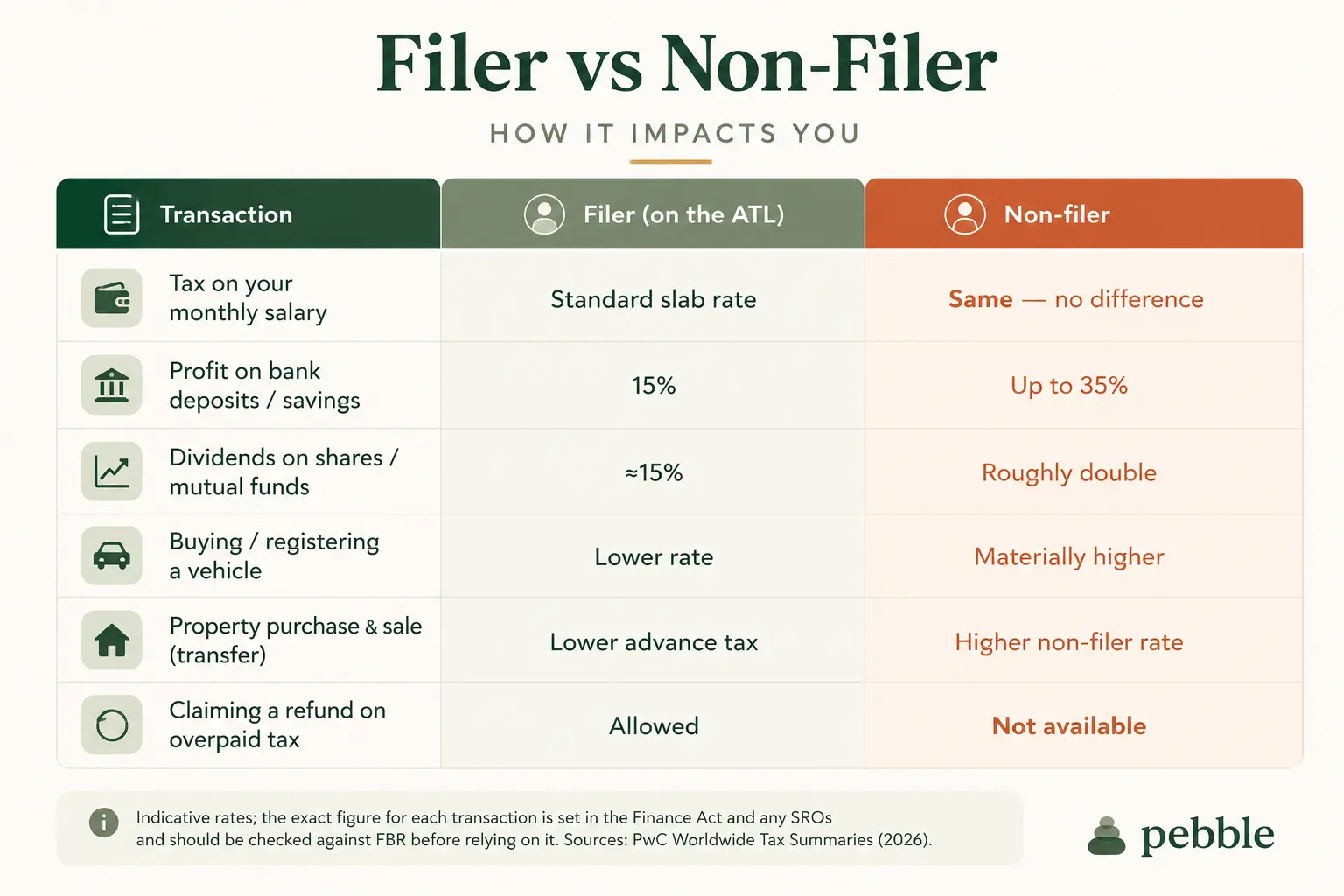
The pattern is consistent: the state can't easily tax a non-filer's income directly, so it taxes their transactions at a higher rate as an incentive to file. For anyone who saves, invests, or owns property, that incentive is large.
How much more does a non-filer really pay?
Enough to notice within a single year. Take a simple, common case: Rs 1,000,000 sitting in a savings account earning about 10% — that's Rs 100,000 of profit in the year. A filer has 15% withheld (Rs 15,000). A non-filer has up to 35% withheld (Rs 35,000). The non-filer loses Rs 20,000 more — purely for not being on a list they could join for free.
Now widen the lens. Add a car purchase, a property transfer, and dividends from a few mutual fund units or PSX shares, and the non-filer's annual penalty easily runs into six figures. Filing your return — which is free and online — is almost certainly the highest-return hour of admin you'll do all year.
Worth pausing on: the Rs 20,000 a filer saves in that one example isn't just "saved" — it's money that stays in your hands to invest. Redirected into a fund or digital gold and left to compound, the filer's edge quietly becomes part of the wealth-building engine, not just a smaller deduction. The cheapest financial upgrade in Pakistan is a signature on a tax return. If you're ready to put that saving to work, see how to start investing in Pakistan.
"But filing means I'll end up paying more tax" Is that true?
For a typical salaried person, almost never. If your employer has been deducting tax correctly all year, filing usually confirms a zero balance — you're declaring income that's already been taxed at source, not handing over a fresh payment (PwC, 2026).
The fear comes from conflating two things: paying tax and declaring it. Filing is the declaration. The wealth statement you submit alongside it simply lists your assets and liabilities so they reconcile with your income — it's a disclosure, not a bill. The people who genuinely owe more at filing are usually those with significant untaxed side income, not salaried employees with a clean salary certificate.
In other words, the realistic outcome of filing for most readers is: no extra tax, plus the lower filer rates on everything else. That's the opposite of the fear.
How do you become a filer and check you're on the ATL?
You file your return on FBR's IRIS portal, and within the next weekly ATL update your name appears as a filer. For a salaried person the whole thing takes under an hour once your CNIC, salary certificate, and bank details are in one place — the same process covered in our step-by-step guide to registering on IRIS and finding your NTN.
To check your status in 30 seconds, SMS the word ATL, a space, then your CNIC number without dashes, to 9966. You can also search the ATL on FBR's website. If you've just filed, allow for the weekly refresh before your name shows.
Missed the 30 September deadline? You're not locked out. You can still file and join the ATL as a late filer by paying a surcharge of Rs 1,000 for an individual (Rs 10,000 for an AOP, Rs 20,000 for a company) — you'll be flagged "late," but you stop paying non-filer rates going forward (FBR, 2026).
Frequently Asked Questions
Is income tax on salary different for filers and non-filers?
No. The salary tax slabs are identical for both — your employer withholds the same amount whether or not you file. Filing changes the withholding rate on your other money: bank profit, dividends, property, and vehicles, where non-filers pay roughly two to four times more (PwC; Akbar Tax Store, 2026).
How much more tax does a non-filer pay on bank profit?
On profit from bank deposits, a filer pays 15% withholding while a non-filer pays up to 35%. On Rs 100,000 of annual profit, that's Rs 15,000 versus Rs 35,000 — a Rs 20,000 gap for the same savings, simply because one person filed their return and the other didn't (Akbar Tax Store, 2026).
Will becoming a filer make me pay more tax overall?
Usually not, if you're salaried. When your employer has withheld tax correctly all year, your return typically confirms a zero balance rather than creating a new bill. The wealth statement is a disclosure of assets, not a charge. Filing then unlocks the lower filer rates on everything else (PwC, 2026).
How do I check if I'm a filer or on the ATL?
Send an SMS to 9966 with the word "ATL", a space, and your CNIC without dashes, and you'll get your status by reply. You can also search the Active Taxpayer List on FBR's website. The list updates weekly, so allow a few days after filing for your name to appear.
What is a "late filer" in Pakistan?
A late filer is someone who files after the 30 September deadline. You can still get onto the Active Taxpayer List by filing and paying a surcharge — Rs 1,000 for an individual, Rs 10,000 for an AOP, and Rs 20,000 for a company. Until you do, you're treated as a non-filer and charged the higher rates (FBR, 2026).
Can non-filers claim a tax refund?
No. Only filers can claim back tax they've overpaid during the year, typically within about two years of filing. A non-filer who has had excess tax withheld simply loses it. For anyone with bank profit or dividends taxed at source, this is another reason the filer route pays for itself.
The bottom line
The filer-versus-non-filer choice isn't really about your salary — that tax is the same either way. It's about every other rupee: the profit on your savings, the dividends on your investments, the tax on your next car or flat, and your ability to claim a refund. On all of those, the non-filer quietly overpays, often by far more than the effort of filing would ever cost.
So before 30 September 2026, do the one-hour job: file your Tax Year 2026 return, get on the Active Taxpayer List, and stop paying the non-filer surcharge on your own money. Then take what you save and put it somewhere it can grow.
This guide explains the system in plain terms; it isn't personal tax advice. Withholding rates change with each Finance Act and depend on your exact transactions. For anything specific, confirm with FBR's resources or a registered tax adviser.
Sources
- Federal Board of Revenue (FBR). "Budget 2026-27 — Salient Features." Retrieved 2026-06-29, from https://fbr.gov.pk/Budget2026-27/SalientFeatures/Salient-Feature.pdf
- FBR. "Active Taxpayer List (Income Tax)." Retrieved 2026-06-29, from https://fbr.gov.pk/active-taxpayer-list-income-tax/
- PwC Worldwide Tax Summaries. "Pakistan — Individual — Taxes on personal income." Retrieved 2026-06-29, from https://taxsummaries.pwc.com/pakistan/individual/taxes-on-personal-income
- PwC Worldwide Tax Summaries. "Pakistan — Individual — Tax administration." Retrieved 2026-06-29, from https://taxsummaries.pwc.com/pakistan/individual/tax-administration
- PwC. "Tax Memorandum on the Finance Bill 2026." 13 June 2026. Retrieved 2026-06-29, from https://www.pwc.com.pk/en/Tax/Momendrum/AFF_Tax_Memorandum_on_Finance_Bill_2026.pdf