
How Inflation Quietly Shrinks Your Savings (With Real Rupee Numbers)
At 11.7% inflation, Rs 100,000 in cash buys only ~Rs 53,000 worth of goods in five years. Here's how inflation drains savings and how to stop it
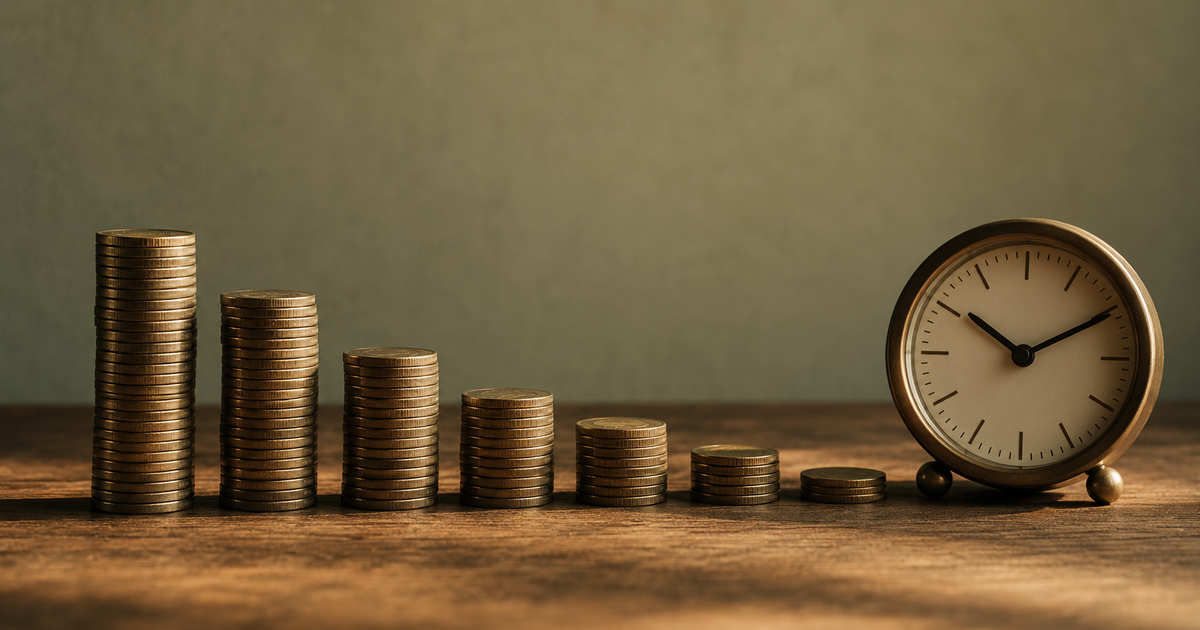
Inflation shrinks your savings by making every rupee buy less over time. At 11.7% inflation in 2026, Rs 100,000 left in cash will buy only about Rs 53,000 worth of goods in five years (State Bank of Pakistan, 2026). Even a savings account paying 8% loses ground, because it trails inflation by nearly 4% every year.
The damage is quiet, which is what makes it dangerous. Your bank balance never goes down, so it feels safe. But what that balance can buy is slipping away month after month. Let's make the invisible visible, with real numbers.
Key Takeaways
- At 11.7% inflation, cash loses about half its purchasing power in five years. Over the last five years, roughly 100% cumulative inflation has already halved the value of idle money (2026).
- A savings account paying 8% still loses about 3.7% a year in real terms, and the rupee has fallen from about 103 to 280 per US dollar since 2015 (exchange-rate data, 2026).
- The fix isn't to spend faster. It's to move long-term money into assets that outpace inflation, like funds, equities, and gold.
How does inflation actually shrink your savings?
It widens the gap between the number in your account and what that number can buy. Economists call these nominal value and real value. Your nominal balance is the rupee figure. Your real balance is its purchasing power. Inflation pulls the two apart.
Say you keep Rs 100,000 in cash for a year while inflation runs at 11.7%. The balance still reads Rs 100,000, but it now buys what about Rs 88,300 bought a year ago. You didn't spend a rupee, yet you're poorer. Repeat that for five years and nearly half the value is gone (State Bank of Pakistan, 2026).
The cruel twist is that this feels like safety. Cash doesn't crash, so people call it "low risk." But a guaranteed slow loss is still a loss. Inflation is the risk you don't see coming.
What your savings account is really worth over time
The balance climbs while its value quietly falls. This is the part that fools almost everyone. A savings account paying 8% grows your nominal balance every year, so the statement looks reassuring. But against 11.7% inflation, the real value, what the money can buy, drops the whole time.
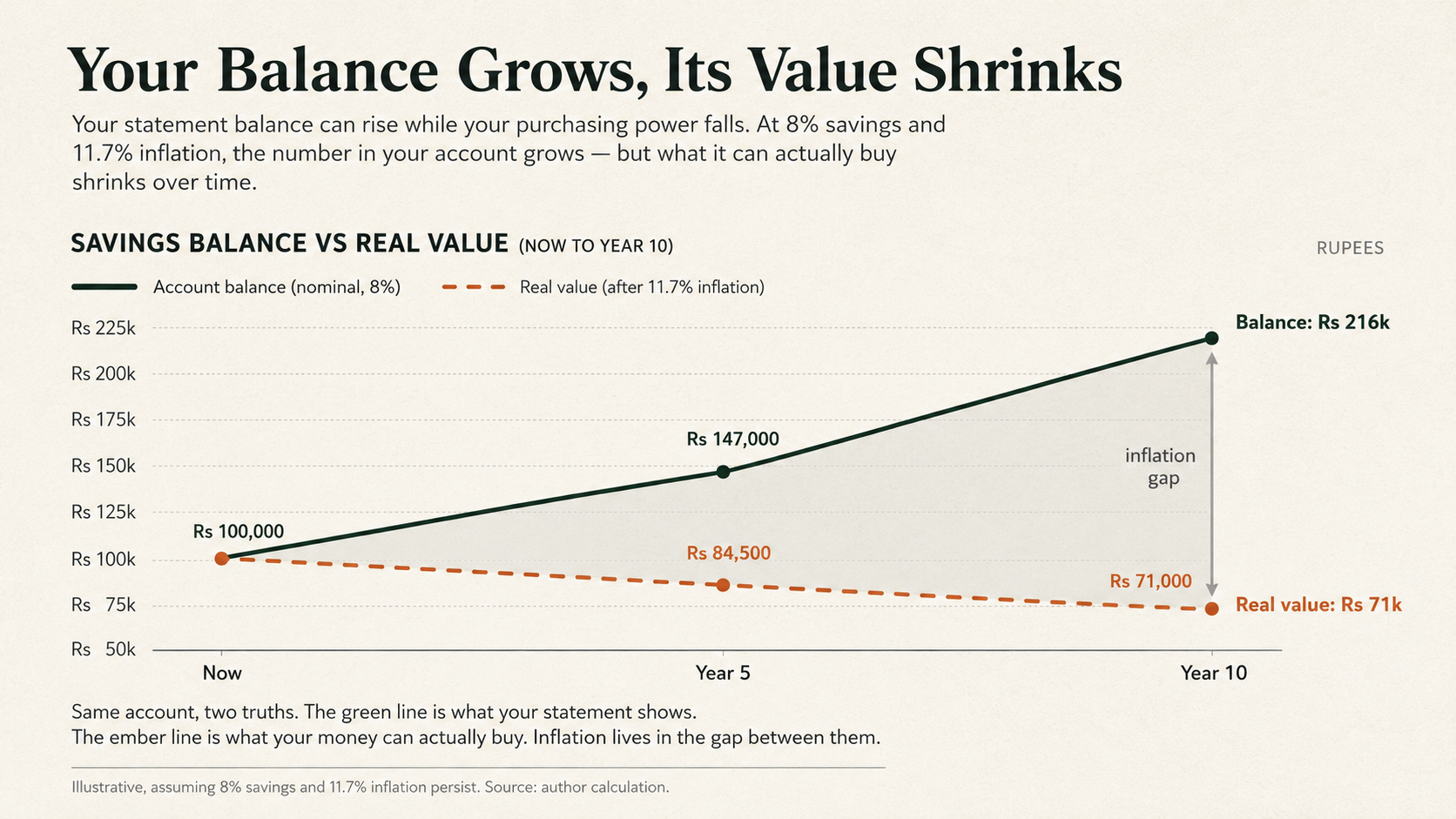
This is why a savings account is a fine place for your emergency fund but a poor place for long-term wealth. It protects access, not value.
How much has the rupee already lost?
A lot, and faster than most people realise. This isn't a future worry; it has already happened. The rupee fell from about 103 per US dollar in 2015 to around 280 in 2026 (exchange-rate data, 2026), and the last five years alone brought roughly 100% cumulative inflation.
Put in everyday terms: money saved in 2015 has lost roughly half its purchasing power. By some measures, Rs 100,000 saved in 2010 buys what Rs 400,000 or more buys today. If your savings have sat in cash through that period, they didn't stay still. They quietly shrank.
The volatility matters too. Inflation was about 3.5% in 2025 and is back to 11.7% in 2026. You can't predict any single year, which is exactly why parking long-term money in cash and hoping is such a fragile plan.
Why "playing it safe" is the riskiest choice
Because the safe-feeling option carries a hidden, guaranteed cost. Most people keep savings in cash, a current account, or a committee precisely to avoid risk. But against 11.7% inflation, that choice locks in a loss, while the "risky" option of investing is what has historically preserved value.
Here's the uncomfortable maths. Only about 4% of Pakistani savers use formal financial institutions (State Bank of Pakistan, 2025), so the vast majority hold money where it earns nothing and loses the full 11.7%. The instinct to "keep it safe" is, in real terms, the single most expensive financial decision millions of Pakistanis make every year. Safety from volatility is not the same as safety from loss.
That instinct is deeply human, and we explore why in the psychology of money. But understanding it is what lets you override it.
How to stop inflation eating your savings
Split your money by timeline, and put the long-term portion to work. You don't need to abandon safety. You need to stop using a safety tool for a growth job.
- Keep your emergency fund in savings. Three to six months of expenses should stay accessible, even if it trails inflation. That's the price of safety, and it's worth paying.
- Move long-term money into assets that outpace inflation. Equity funds (the KSE-100 has averaged about 12% a year), diversified mutual funds, and gold have historically beaten cash over time (Trading Economics, 2026).
- Invest consistently, not all at once. A fixed monthly amount smooths out the ups and downs and builds the habit.
If you're weighing the options, compare mutual funds vs PSX vs digital gold, and learn how much you really need to start.
Frequently Asked Questions
How does inflation reduce the value of savings?
Inflation raises prices, so each rupee buys less over time. At 11.7% inflation, Rs 100,000 in cash buys about Rs 88,300 worth of goods after one year and roughly half after five, even though the balance never falls. The loss is in purchasing power, not the number (State Bank of Pakistan, 2026).
Does a savings account protect me from inflation?
Only partly. A savings account paying about 8% still loses around 3.7% a year against 11.7% inflation. The nominal balance grows while real value falls. Savings accounts are good for emergency funds but poor for growing long-term wealth.
How much value has the rupee lost?
A great deal. The rupee fell from about 103 to 280 per US dollar between 2015 and 2026, and the last five years saw roughly 100% cumulative inflation. Money saved in cash over that period has lost roughly half its purchasing power.
What should I do to protect my money?
Keep 3-6 months of expenses in savings for safety, and invest the rest in assets that historically beat inflation, such as equity funds, diversified mutual funds, and gold. Investing consistently each month spreads risk and builds the habit.
Isn't keeping cash the safest option?
Not in real terms. Cash feels safe because it doesn't fall in value on paper, but at 11.7% inflation it loses purchasing power every year. Safety from market swings is not the same as safety from inflation, which is a slow, guaranteed loss.
The bottom line
Inflation is a thief that never trips the alarm. Your balance stays put, your statement looks fine, and all the while your money buys less. At 11.7%, and with the rupee a third of its 2015 value, the cost of doing nothing is real and rising.
The answer isn't to spend in a panic. It's to give your long-term money a job that can outrun inflation, while keeping a safety net you can reach. Protect what you'll need soon. Grow what you won't.
Ready to put your savings to work? Here's how to start investing in Pakistan.
Sources
- State Bank of Pakistan / Pakistan Bureau of Statistics, via Business Recorder. "Pakistan inflation hits 11.7% in May 2026, highest since June 2024." Retrieved 2026-06-11, from https://www.brecorder.com/news/amp/40423444
- Wise. "PKR to USD Exchange Rate History." Retrieved 2026-06-11, from https://wise.com/us/currency-converter/usd-to-pkr-rate/history
- Trading Economics. "Pakistan Stock Market (KSE-100) — Returns and Historical Data." Retrieved 2026-06-11, from https://tradingeconomics.com/pakistan/stock-market
- State Bank of Pakistan. "National Financial Inclusion Strategy / Financial Inclusion Index." 2025. Retrieved 2026-06-11, from https://www.sbp.org.pk/ACMFD/National-Financial-Inclusion-Strategy-Pakistan.pdf
- HisaabKaro. "Pakistan Inflation Calculator — PKR Purchasing Power (1960-2026)." Retrieved 2026-06-11, from https://hisaabkaro.com/inflation-calculator/