
Mutual Funds vs Stocks in Pakistan: How to Choose Your First Investment
Mutual funds, PSX shares, digital gold, or a fixed deposit? A plain-language guide to how each works in Pakistan the fees, the effort, and the risk so you can pick your first one with confidence

You've saved a little. You want it to do more than sit in a drawer or a current account. Then you freeze.
Mutual funds? PSX shares? Digital gold? Each one works differently, costs differently, and asks a different amount of your time. This guide walks through the four options a Pakistani beginner actually faces what each is, how it works here, what it costs, and who it tends to suit so you can pick your first one without second-guessing. No jargon, no hype, and no promises about what you'll earn, because nobody can honestly make those.
If you haven't taken the very first step yet, our beginner's roadmap to investing in Pakistan covers everything that comes before this decision.
Key Takeaways
- A stock is a share of one company you pick yourself; a mutual fund pools your money with others under a manager licensed by the SECP (MUFAP, retrieved 2026-07-06).
- All four options here can rise or fall in value — and a fixed deposit's real worth can be quietly eroded by inflation. None guarantees a gain.
- The honest question for a beginner isn't "which earns the most?" It's "how much time, knowledge, and nerve do I have?"
- You can start small and switch later. The vehicle matters less than the habit of investing regularly and holding.
The four options at a glance
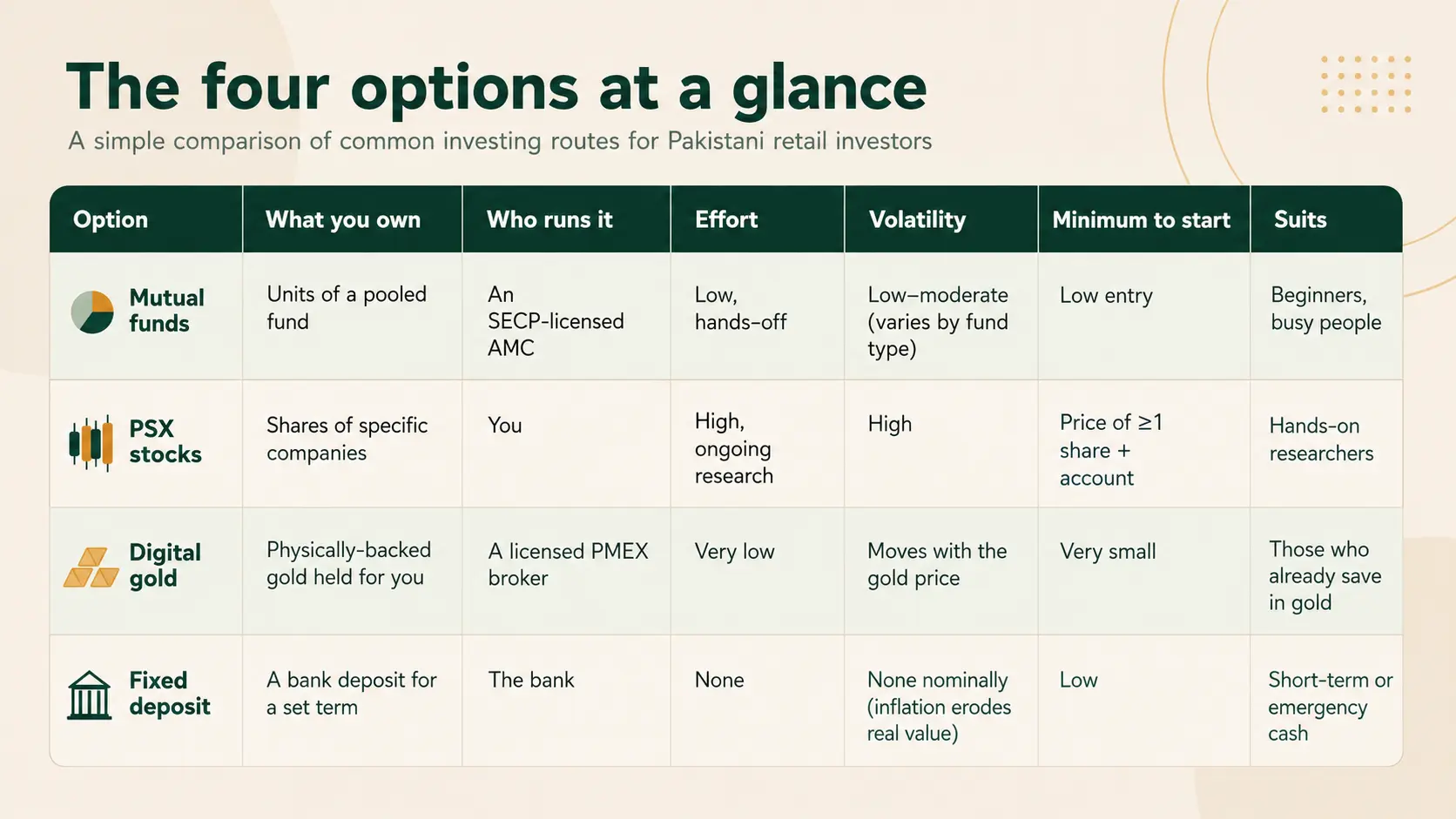
There's no "returns" column here on purpose. Past performance doesn't predict future results, and anyone quoting you a guaranteed number is selling, not advising.
Option 1 — Mutual funds: the hands-off start
A mutual fund hands the day-to-day decisions to a professional. Your money joins a pool run by an asset management company (AMC) licensed by the SECP, which spreads it across shares, bonds, and money-market instruments. You own units of the combined portfolio (MUFAP, retrieved 2026-07-06).
One detail matters a lot for safety: an independent trustee, registered with the SECP, holds the fund's assets — separate from the company managing them (MUFAP, retrieved 2026-07-06). Most retail funds are open-ended, so you buy or redeem units at the fund's Net Asset Value (NAV), which the manager announces daily.
Funds come in a few broad types, and the industry's money sits unevenly across them:
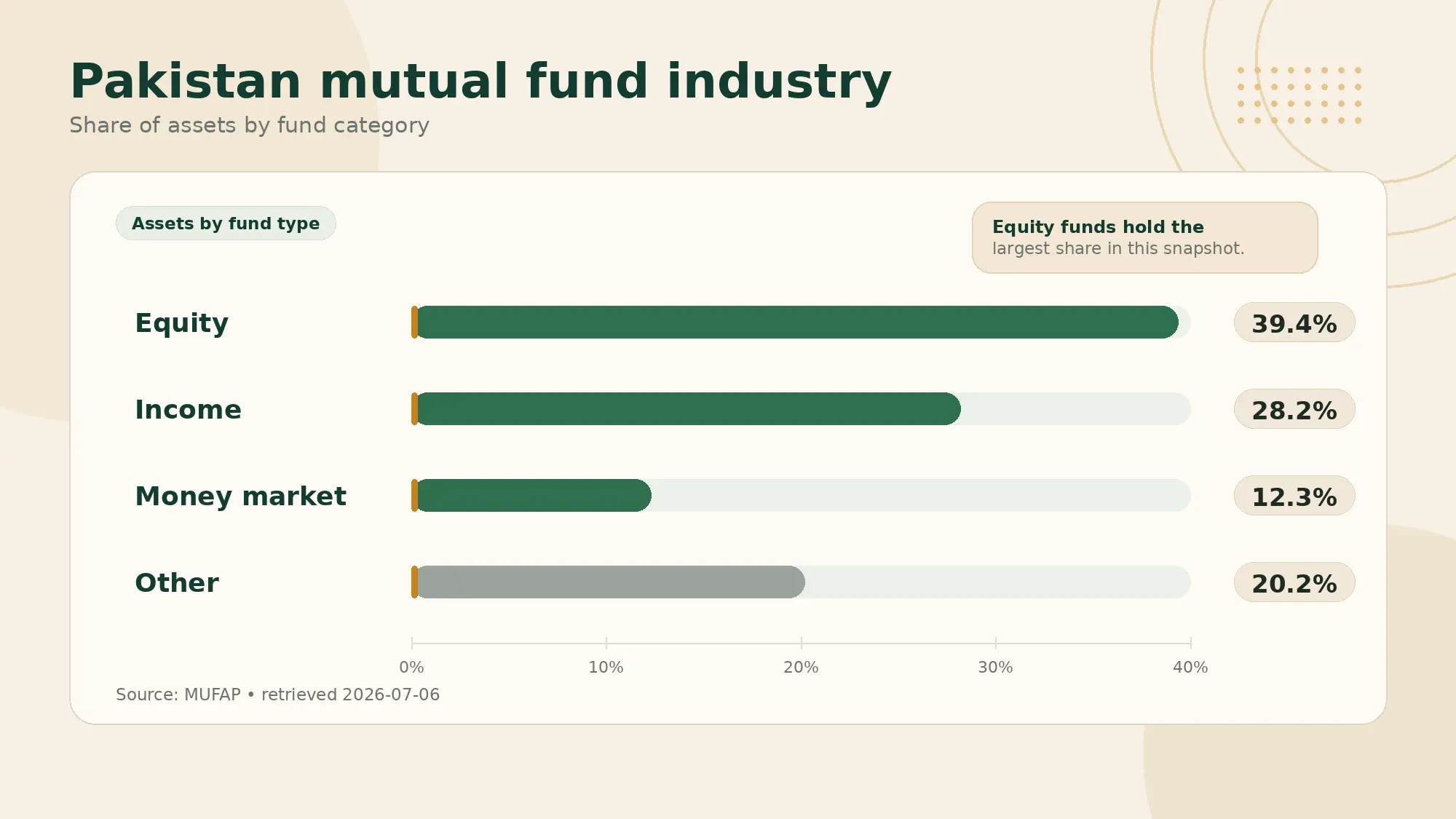
Each type carries a different risk level. Equity funds swing more with the market; money-market funds aim to be steadier. So "a mutual fund" isn't one setting — it's a menu.
What it costs: an annual management fee (an expense ratio) built into the unit price, so you never write a separate cheque. The SECP caps these fees which is around 3-4%. What it doesn't do: promise a number. Values move both ways.
Effort: low — this is the whole selling point. You get instant diversification across many holdings without picking any of them yourself. Best suited to someone new, busy, or who'd simply rather not watch a screen.
Option 2 — PSX individual stocks: the hands-on path
Buying stocks means choosing individual companies and trading their shares on the Pakistan Stock Exchange (PSX), which operates under SECP oversight (PSX, retrieved 2026-07-06). You own a slice of that specific business, and you can also earn dividends when a company pays them.
To start, you'll generally need a brokerage account, a CDC sub-account (where your shares are held electronically), and your CNIC . When you sell, capital-gains tax may apply depending on how long you held.
The appeal is control — you can back a company you understand and follow closely. The catch is that control cuts both ways. A portfolio of one or two names lives and dies on those specific businesses, and prices can fall hard and fast. Building real diversification yourself takes many shares and steady attention. Even the market's own benchmark keeps shifting: the KSE-100 index was recomposed on 14 March 2025 (PSX Data Portal, retrieved 2026-07-06).
Effort: high — research, earnings, and monitoring, most weeks. Volatility: high. Best suited to someone who enjoys the homework, has the time, and can hold through a drop without panic-selling.
Option 3 — Digital gold: the low-effort, familiar option
Plenty of Pakistani families already save in gold. Digital gold keeps that instinct but drops the hassle: you own physically-backed gold in small amounts, held for you through a licensed PMEX brokerage, and you can sell back to cash anytime — without a locker, a dealer, or the theft-and-storage worry. (This is Pebble's own area, so treat the next lines as the mechanism, not a pitch.)
You own real metal recorded in your name, rather than a number with nothing behind it. There's a small buy/sell spread and possibly a holding cost. Effort: very low. Volatility: gold prices move both ways — digital gold removes the storage risk of physical gold, not the price risk, and it's no guaranteed hedge. If you're weighing it up, our guide on whether digital gold is safe in Pakistan walks through what to check first.
Best suited to someone who already trusts gold, wants a low-effort start, or wants to hold a little alongside other options.
Option 4 — Fixed deposits: the predictable parking spot
You lock a sum with a bank for a set term, and at maturity you receive your principal plus a pre-agreed profit or interest. It's predictable and low-drama, which is exactly the point.
The catch is quieter than volatility: in a high-inflation stretch, a fixed nominal return can still lose purchasing power. Your money is "safe" in rupee terms but may buy less by the time it matures. Bank deposits are protected up to a limit by Pakistan's Deposit Protection Corporation.
Effort: none. Volatility: none nominally. Best suited to money you'll need soon, or an emergency buffer — not long-term growth.
Which should you choose? Three honest questions
You don't need a spreadsheet. You need to answer three things truthfully.
1. How much time can you give it each week?
- Near zero → mutual funds or digital gold
- An hour or two → mutual funds
- Several hours, and you enjoy it → PSX stocks
2. When might you need the money?
- Under a year → fixed deposit or digital gold
- One to five years → mutual funds
- Five years or more → PSX stocks, or a fund-led mix
3. Could you watch your investment fall and not panic-sell?
- No → lean to steadier options
- Yes, and I can hold through it → stocks are on the table
For a first-timer, the real risk usually isn't picking the "wrong" product — it's behaviour. Concentrated bets tempt you to check prices daily and sell at the worst moment. A hands-off option quietly removes most of those buttons to press. Sometimes the most useful feature is the one that stops you interfering.
A simple way to structure your first Rs 50,000
Think of these as illustrations of how beginners tend to structure things — not advice to buy any specific product, and with no promised outcome attached:
- No time to monitor: one diversified fund, checked about once a month.
- Some time, a five-year horizon: mostly a fund, a couple of blue-chip shares to learn on, and a little gold.
- Nervous about volatility: lean steadier — some gold, a fund, and a fixed deposit for the emergency slice.
Whatever the split, the point is to start and stay consistent. The vehicle you choose matters far less than whether you keep going.
Common first-timer regrets (and how to sidestep them)
Most regrets trace back to a few predictable errors. Our full guide to the investment mistakes Pakistani beginners make covers more; here are the three tied to vehicle choice:
- "I put everything into one random stock." Start diversified — a fund, or several shares — and add single-stock bets only once you've found your footing.
- "I panic-sold during a dip." Decide your holding period in writing before you invest, and read it back to yourself when the market wobbles.
- "The fees surprised me." Fees matter — but your behaviour matters more. Holding a low-cost fund calmly for years tends to beat jumping in and out.
Our take: Start with the option that fits your life, not the one with the best story attached. None of these promises a gain — so the habit you can keep beats the bet you can't.
Frequently Asked Questions
Can I start with mutual funds and move to stocks later?
Yes — and many people do exactly that. Beginning with a fund while you learn, then adding individual shares once you're comfortable, is a common path. There's no penalty for switching, so you don't have to get the "final" answer right on day one.
Are mutual funds safer than stocks in Pakistan?
Mutual funds spread your money across many holdings, so a single bad position hurts less than in a concentrated stock portfolio. Both are regulated by the SECP and both can still lose value — diversification lowers the odds of one big mistake, it doesn't remove market risk (MUFAP, retrieved 2026-07-06).
Can you lose money in a mutual fund?
Yes. A fund's value is tied to the assets it holds, and those prices move both ways, so your units can fall — especially over short periods. Funds don't promise returns, and different types (equity vs money-market) carry different levels of risk (MUFAP, retrieved 2026-07-06).
Who regulates mutual funds and stocks in Pakistan?
The Securities and Exchange Commission of Pakistan (SECP) oversees both. Stocks trade on the SECP-regulated PSX, while mutual funds are run by SECP-licensed AMCs, with an independent SECP-registered trustee holding the fund's assets (PSX; MUFAP, retrieved 2026-07-06).
Do I need a lot of money to start?
No. Each path can be started with a modest amount, and mutual funds often have a lower practical entry point since you buy units rather than whole shares plus commission [verify typical minimums]. Regular small contributions matter more than a large one-off amount. See how much money you need to start investing in Pakistan.
How is gold different from stocks and mutual funds?
Gold is a physical asset many families already hold; stocks and funds are financial securities regulated by the SECP. Digital gold lets you own physically-backed gold in small amounts through a licensed PMEX brokerage. Like shares and funds, gold prices move both ways and offer no guaranteed return.
Your next step
You don't need the perfect pick today. Understand what you're buying, who regulates it, and whether you can get your money out — then start small and stay consistent. If you'd like plain-language explainers like this one as we publish them, join the Pebble newsletter and learn at your own pace.
Sources
- Mutual Funds Association of Pakistan (MUFAP) — industry overview, fund types, regulatory structure. Retrieved 2026-07-06. https://www.mufap.com.pk/
- MUFAP — Asset Allocation / monthly industry statistics (fund-type shares). Retrieved 2026-07-06. https://www.mufap.com.pk/Industry/IndustryStatMonthly?tab=1
- Pakistan Stock Exchange (PSX) — exchange overview and SECP oversight. Retrieved 2026-07-06. https://www.psx.com.pk/
- PSX Data Portal — KSE-100 recomposition (14 March 2025). Retrieved 2026-07-06. https://dps.psx.com.pk/
- Securities and Exchange Commission of Pakistan (SECP) — regulator. Retrieved 2026-07-06. https://www.secp.gov.pk/