
Saving vs Investing in Pakistan: What's the Difference (and Why It Matters)?
A savings account paying 8% still loses to 11.7% inflation in 2026. Here's the real difference between saving and investing—and how much to do of each.
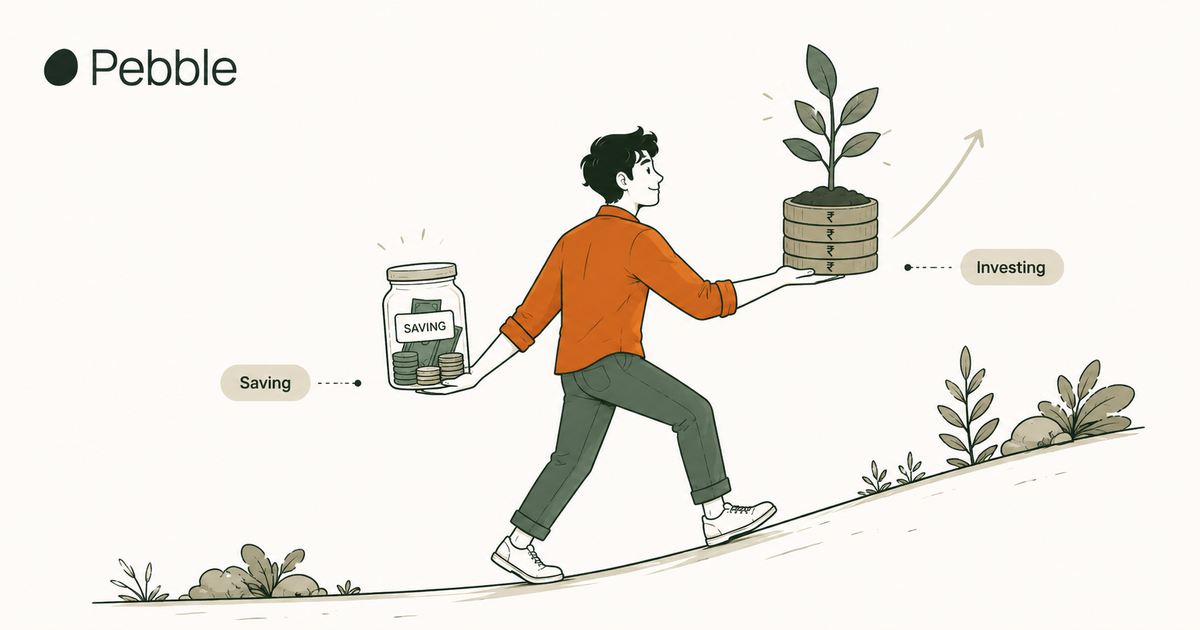
Saving means setting money aside in a safe, easy-to-reach place for short-term needs. Investing means putting money into assets that grow over years. The difference matters more than ever in 2026: a savings account paying around 8% still trails 11.7% inflation (State Bank of Pakistan, 2026), while long-term investing aims to stay ahead of it.
Both have a job. The mistake most people make isn't choosing wrong, it's using a savings account as a wealth plan and wondering why they never get ahead. Let's untangle the two.
Key Takeaways
- A typical Pakistani savings account pays about 6-9%, still below 11.7% inflation, so even good savings slowly lose real value. Cash and committees earn roughly 0% and lose the full 11.7% (State Bank of Pakistan, 2026).
- The SBP policy rate is 11.5% as of April 2026, so deposit rates are relatively high right now, yet the KSE-100 has historically returned around 18% a year over the long run, dividends included (Business Recorder, 2026).
- The rule of thumb: keep 3-6 months of expenses in savings for safety, and invest the rest for growth. You need both, for different jobs.
What's the real difference between saving and investing?
Saving is about safety and access; investing is about growth over time. When you save, your priority is that the money is there, in full, whenever you need it. When you invest, you accept some short-term ups and downs in exchange for the chance to grow well above inflation over years.
| Saving | Investing | |
|---|---|---|
| Purpose | Short-term safety | Long-term growth |
| Access | Immediate | Hold 5+ years |
| Return (2026) | ~6-9% | ~9-18% (long-term) |
| vs 11.7% inflation | Loses real value | Aims to beat it |
| Risk | Very low (nominal) | Varies; eased by time + spread |
| Examples | Savings account | Funds, PSX shares, gold |
Think of saving as the foundation of a house and investing as the floors you build on top. You wouldn't build floors without a foundation, but a foundation alone isn't somewhere you can live.
Does a savings account beat inflation in Pakistan?
Not right now, and usually not over the long run. With inflation at 11.7% in 2026 and a good savings account paying around 8%, your money still loses about 3.7% of its real value each year (State Bank of Pakistan, 2026). Cash kept at home or in a committee earns nothing and loses the full 11.7%.
Here's how the main options stack up against the inflation line today:
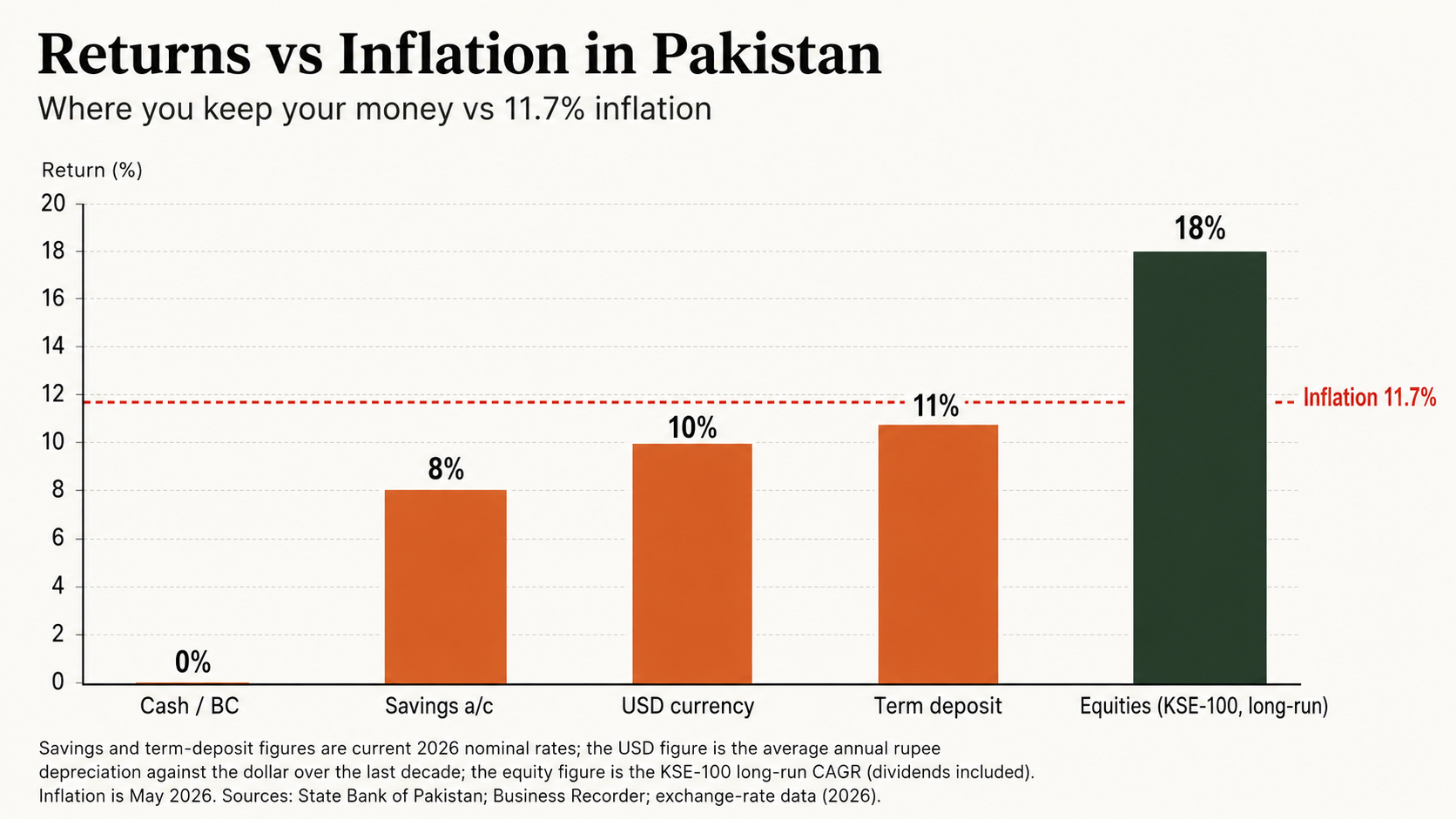
Here's the nuance most articles skip. In a single high-inflation year, almost nothing comfortably beats inflation. The case for investing isn't about winning every year. It's that inflation rises and falls (it was around 3.5% in 2025), while the KSE-100's long-run return of around 18% a year (dividends included) compounds steadily above Pakistan's typical inflation. Cash never gets that chance.
When should you save, and when should you invest?
Save for anything you'll need within two years; invest for anything five or more years away. Money for rent, a wedding next year, or a medical buffer belongs in savings, where it's safe and instant. Money for retirement, a child's education, or long-term wealth belongs in investments, where time can grow it.
The grey zone is two to five years. There, a cautious mix works: lower-risk options like money market funds or term deposits, rather than volatile equities. The key question is simple: when will I need this money? Your answer decides the tool.
This is also where behaviour matters. Selling investments in a panic during a dip is one of the most common mistakes Pakistani beginners make, and it usually happens when people invest money they actually needed for the short term. Match the money to the timeline, and you remove the temptation.
How much should go into each?
Build the safety net first, then grow everything above it. A widely used rule is to keep 3 to 6 months of essential expenses in savings before you invest seriously. That cushion is what stops a job loss or emergency from forcing you to sell investments at the worst possible moment.
A simple sequence:
- Save a starter buffer of one month's expenses.
- Clear expensive debt, like credit cards.
- Build the buffer to 3-6 months in a savings account.
- Invest the surplus, ideally 10-20% of your income, every month.
- Increase the investing share as your income grows.
Only about 4% of Pakistani savers use formal financial institutions (State Bank of Pakistan, 2025), which means most people never reach step four. Getting there is the whole game.
How do you start investing the money beyond your safety net?
Start small, automate it, and keep it boring. Once your emergency fund is in place, the surplus is exactly the money that should be working harder than 8% in a savings account. A single balanced mutual fund, funded monthly, is the classic first move.
If you're not sure how much you need to begin, the honest answer is "less than you think," as we cover in how much money you really need to start. To choose between options, see our comparison of mutual funds vs PSX vs digital gold. And for the full first-timer walkthrough, follow the roadmap to start investing in Pakistan.
Frequently Asked Questions
Is saving or investing better in Pakistan?
Neither is "better"; they do different jobs. Saving keeps short-term money safe but loses to 11.7% inflation. Investing aims to beat inflation over 5+ years but carries short-term risk. Keep 3-6 months of expenses saved, and invest the rest (State Bank of Pakistan, 2026).
Why isn't a savings account enough?
Because it rarely beats inflation. In 2026, a savings account paying about 8% still loses roughly 3.7% in real value against 11.7% inflation, and cash loses the full amount. Savings protect money; only investing reliably grows it above inflation over time (State Bank of Pakistan, 2026).
How much should I keep in savings before investing?
A common rule is 3 to 6 months of essential expenses in an accessible savings account. This emergency fund protects you from having to sell investments during a crisis or market dip, which is when losses are locked in.
Can I lose money by investing?
Yes, investments can fall in the short term, which is why you only invest money you won't need for 5+ years. Spreading money across many assets and holding through the dips has historically delivered around 18% a year on the KSE-100 over the long run, well above cash (Business Recorder, 2026).
Is investing halal compared to keeping money in a bank?
Shariah-compliant options exist for both saving and investing, including Islamic banks, Islamic funds, and sukuk. Pebble doesn't certify any product as halal; the structures are reviewed by Shariah boards, and the final judgement rests with you and a scholar you trust.
The bottom line
Saving and investing aren't rivals. They're teammates with different roles. Saving keeps you safe when life surprises you. Investing keeps you ahead of inflation when life goes to plan.
Get the order right: build your safety net, then put the surplus to work. A savings account at 8% will always lose a quiet race against 11.7% inflation. The money you can leave alone for years deserves a better job than that.
Ready to put your surplus to work? Here's how to start investing in Pakistan, step by step.
Sources
- State Bank of Pakistan / Pakistan Bureau of Statistics, via Business Recorder. "Pakistan inflation hits 11.7% in May 2026, highest since June 2024." Retrieved 2026-06-11, from https://www.brecorder.com/news/amp/40423444
- State Bank of Pakistan, via Business Recorder. "SBP raises policy rate to 11.5% in April 2026." Retrieved 2026-06-11, from https://www.brecorder.com/
- Trading Economics. "Pakistan Stock Market (KSE-100) — Returns and Historical Data." Retrieved 2026-06-11, from https://tradingeconomics.com/pakistan/stock-market
- Business Recorder. "30 years of existence: KSE-100 Index posts average annual returns of 14pc (dividend-adjusted total return; ~19% on an alternative basis)." Retrieved 2026-06-11, from https://www.brecorder.com/news/40110781
- State Bank of Pakistan. "National Financial Inclusion Strategy / Financial Inclusion Index." 2025. Retrieved 2026-06-11, from https://www.sbp.org.pk/ACMFD/National-Financial-Inclusion-Strategy-Pakistan.pdf
- Meezan Bank / Bank AL Habib. "Savings deposit profit rates, 2026." Retrieved 2026-06-11, from https://www.meezanbank.com/