
What Is Inflation, and Why Does It Matter to You in Pakistan?
Inflation hit 11.7% in Pakistan in 2026, and the rupee fell from 103 to 280 per dollar in a decade. Here's what inflation is and how to protect your money.
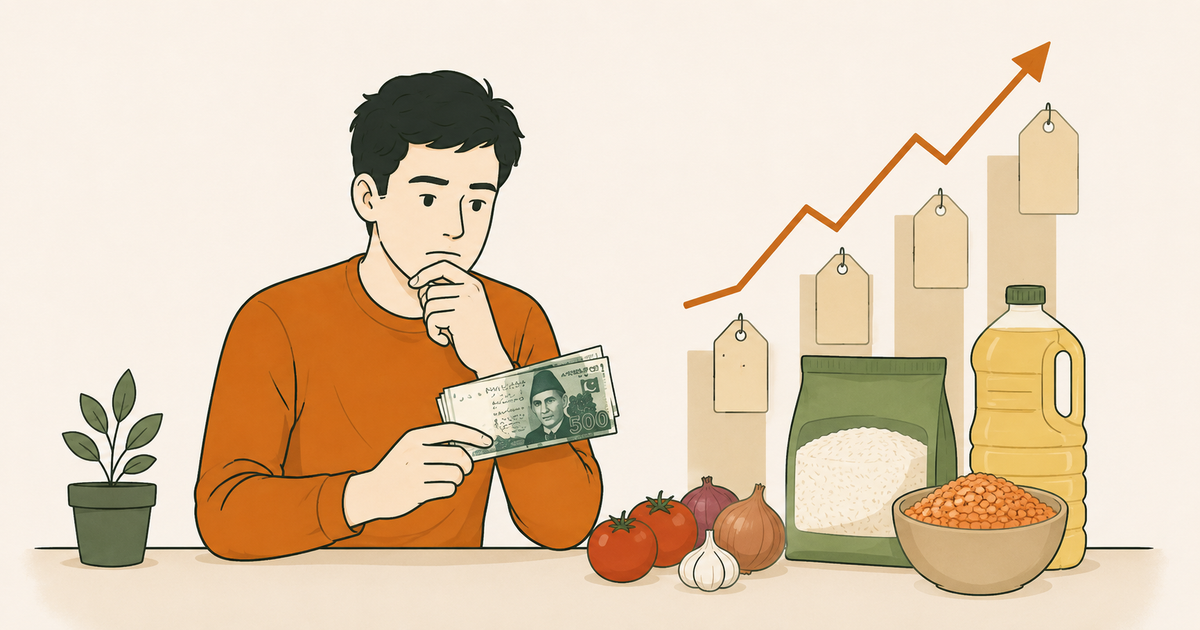
Inflation is the rate at which prices rise and your money's buying power falls. In May 2026, Pakistan's inflation was 11.7%, the highest since June 2024 (State Bank of Pakistan, 2026). In plain terms, something that cost Rs 100 a year ago costs about Rs 111.70 today, and the same rupee in your pocket buys a little less every month.
You feel it at the grocery store, the petrol pump, and in your rent. But inflation isn't just a headline number. It's a quiet tax on every rupee you hold, and understanding it is the first step to staying ahead of it.
Key Takeaways
- Inflation in Pakistan hit 11.7% in May 2026, well above the SBP's 5-7% target. Transport prices rose 36.8% and housing and utilities 16.8% year-on-year (State Bank of Pakistan, 2026).
- Over the last decade the rupee fell from about 103 to 280 per US dollar, and the last five years alone saw roughly 100% cumulative inflation (exchange-rate data; 2026).
- Inflation is the main reason money kept in cash quietly loses value, and the main reason to invest rather than only save.
What is inflation, exactly?
Inflation is a general rise in prices across the economy over time. It's measured by the Consumer Price Index (CPI), which the Pakistan Bureau of Statistics tracks by pricing a fixed "basket" of everyday goods and services, from atta and petrol to rent and electricity. When that basket costs more than it did a year ago, the percentage increase is the inflation rate.
A little inflation is normal and even healthy; the State Bank targets a 5-7% range. The problem is when it runs hot, as it does now at 11.7%, because wages and savings rarely keep pace. Your salary might rise 5% while prices rise 12%, leaving you poorer in real terms even though the number on your payslip went up.
The key word is "real." Nominal value is the rupee figure; real value is what those rupees actually buy. Inflation is the gap between the two, and it's why your money can grow on paper while shrinking in practice.
How high is inflation in Pakistan right now?
It's high and uneven, with some essentials rising far faster than the headline. The May 2026 rate of 11.7% is an average; underneath it, the categories that hit households hardest have climbed much more (State Bank of Pakistan, 2026).
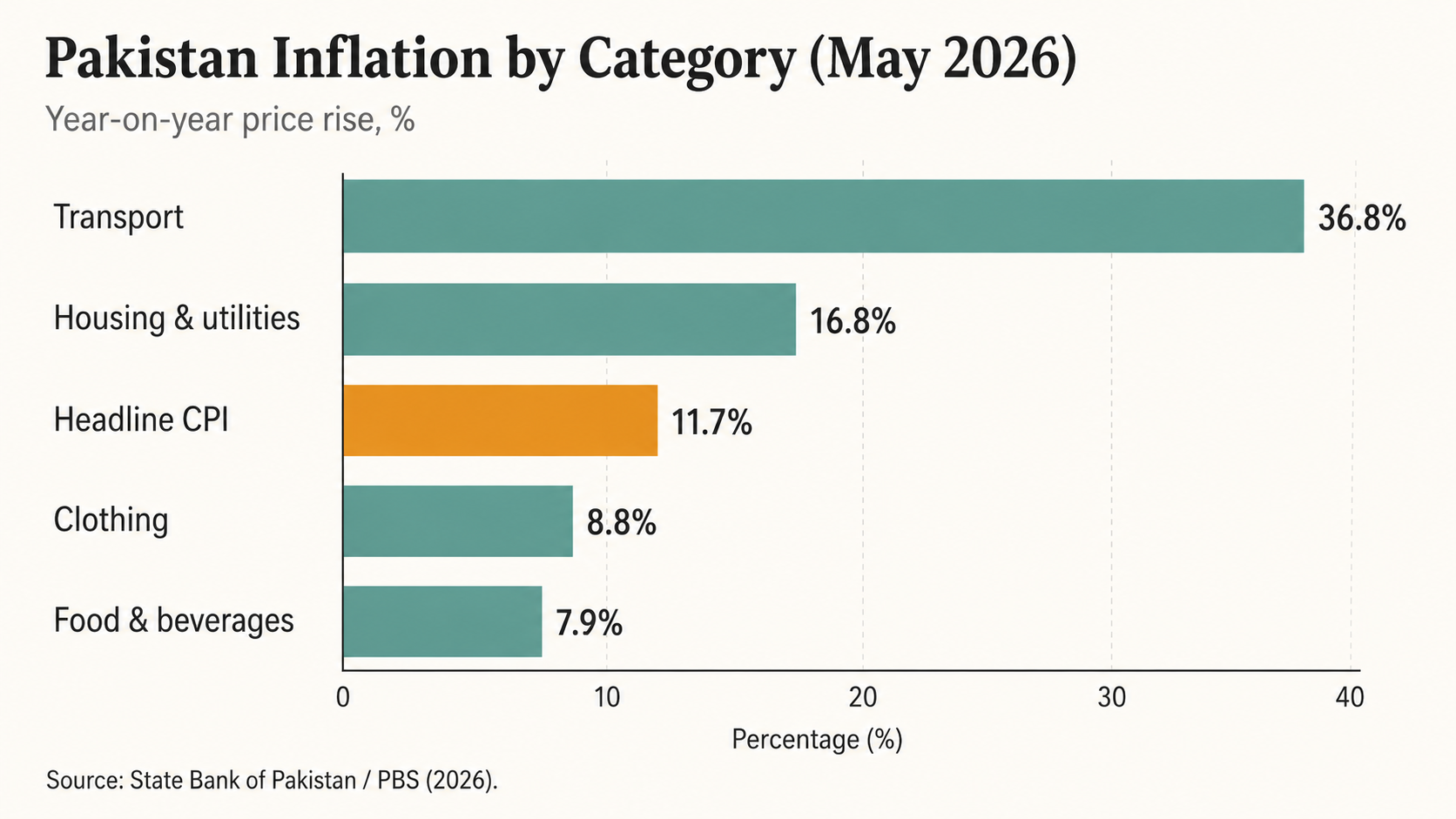
This is why the official figure can feel too low. Your own basket, heavy on transport and rent, may be rising faster than the national average. Inflation is personal.
What causes inflation in Pakistan?
Several forces, but a falling rupee sits at the heart of it. Pakistan imports much of its fuel, machinery, and raw materials, so when the rupee weakens, those imports cost more in rupees, and that feeds through to almost every price.
The scale of that currency slide is easy to underestimate. The rupee fell from about 103 per US dollar in 2015 to around 280 in 2026 (exchange-rate data, 2026). That's not a footnote; it's a core reason imported goods, and anything made with them, have repriced upward for a decade. Domestic inflation and currency depreciation aren't two separate stories. They're the same story.
Other drivers stack on top: energy costs (petrol and diesel surged after recent Middle East tensions), supply shocks like the 2022 floods, government borrowing, and money supply. To cool inflation, the State Bank raises its policy rate, which it lifted to 11.5% in April 2026. Higher rates make borrowing costlier and saving more attractive, gradually slowing price rises, but they also raise the cost of loans for everyone.
How does inflation affect your everyday life and savings?
It shrinks both your spending power and your idle money at the same time. On the spending side, your salary buys less each year unless it rises faster than 11.7%, which most don't. On the saving side, money sitting in cash or a low-return account loses real value silently.
Here's the part that catches people out. A savings account paying 8% feels like growth, but against 11.7% inflation it's a real loss of about 3.7% a year. Cash at home or in a committee earns nothing and loses the full 11.7%. We break this down further in how inflation quietly shrinks your savings.
Over time, this compounds against you. With roughly 100% cumulative inflation over the last five years, money left untouched has lost about half its purchasing power. Doing nothing isn't safe. It's a slow, guaranteed loss.
How do you protect your money from inflation?
By owning assets that tend to rise with, or faster than, prices. Cash can't beat inflation, but several investments historically have, which is the entire case for investing rather than only saving.
- Stocks and equity funds — The KSE-100 has averaged about 12% a year long-term, above typical inflation (Trading Economics, 2026).
- Gold — A long-standing hedge in Pakistan that tends to rise as the rupee falls.
- Diversified mutual funds — Professional, spread-out exposure from as little as Rs 5,000.
None of these wins every single year, especially a high-inflation one. But over time, a diversified mix has protected and grown wealth far better than cash. To see how the options compare, read mutual funds vs PSX vs digital gold, and if you're just beginning, start with what investing is and why it matters.
Frequently Asked Questions
What is inflation in simple words?
Inflation is the rise in prices over time, which lowers what your money can buy. If inflation is 11.7%, something costing Rs 100 last year costs about Rs 111.70 now. It's measured by the Consumer Price Index, tracked by the Pakistan Bureau of Statistics (State Bank of Pakistan, 2026).
Why is inflation so high in Pakistan?
Mainly because the rupee has weakened sharply, from about 103 to 280 per US dollar since 2015, making imports like fuel and machinery costlier. Energy price shocks, floods, and government borrowing add to it. The State Bank raises its policy rate, now 11.5%, to slow it down.
How does inflation affect my savings?
It erodes them. At 11.7% inflation, a savings account paying 8% loses about 3.7% in real value each year, and cash loses the full 11.7%. Over the last five years, roughly 100% cumulative inflation has cut idle money's purchasing power by about half.
What is a good way to beat inflation in Pakistan?
Investing in assets that historically outpace inflation, such as equity funds, gold, and diversified mutual funds. The KSE-100 has averaged about 12% a year long-term. No asset beats inflation every year, but a diversified mix has done so over time far better than cash.
Is some inflation normal?
Yes. A mild 5-7% inflation, the State Bank's target, is considered healthy for a growing economy. The problem is high inflation like today's 11.7%, because wages and savings struggle to keep pace, leaving households poorer in real terms.
The bottom line
Inflation is the reason "keeping your money safe" in cash isn't safe at all. At 11.7%, and with the rupee a fraction of its former self, idle money loses value you can actually feel, year after year.
You can't stop inflation. But you can stop it from quietly draining your wealth, by putting money you don't need soon into assets built to outpace it. The first move is understanding the enemy. The second is acting on it.
Ready to stay ahead of inflation? Here's how to start investing in Pakistan.
Sources
- State Bank of Pakistan / Pakistan Bureau of Statistics, via Business Recorder. "Pakistan inflation hits 11.7% in May 2026, highest since June 2024." Retrieved 2026-06-11, from https://www.brecorder.com/news/amp/40423444
- IndexBox. "Pakistan Inflation Accelerates to 11.7% in May 2026 (PBS data)." Retrieved 2026-06-11, from https://www.indexbox.io/blog/pakistan-inflation-accelerates-to-117-in-may-2026/
- Wise. "PKR to USD Exchange Rate History." Retrieved 2026-06-11, from https://wise.com/us/currency-converter/usd-to-pkr-rate/history
- Trading Economics. "Pakistan Stock Market (KSE-100) — Returns and Historical Data." Retrieved 2026-06-11, from https://tradingeconomics.com/pakistan/stock-market
- State Bank of Pakistan, via Dawn. "SBP policy rate raised to 11.5%, April 2026." Retrieved 2026-06-11, from https://www.dawn.com/